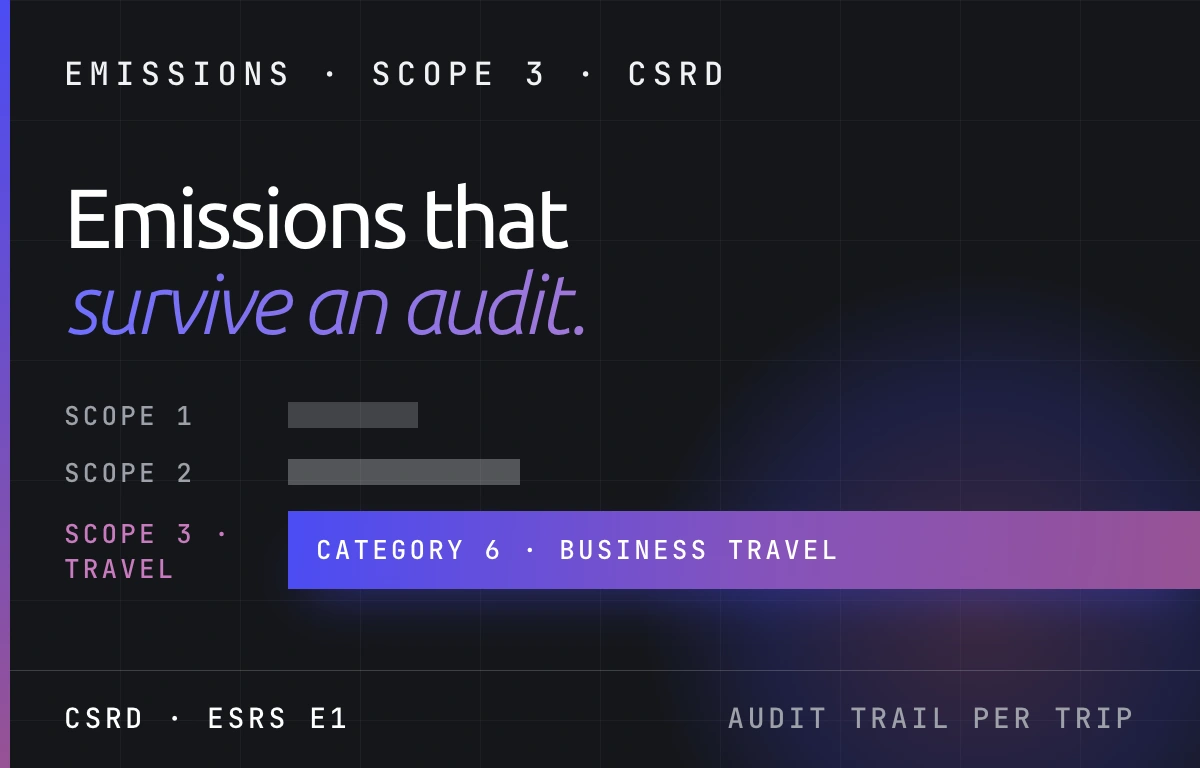
Cogent is PredictX’s agentic AI framework for travel and expense management: specialist AI agents plan, execute and validate complete T&E work for you, and every answer arrives cited, traced to source and auditable.
You read one answer. A team of specialists did the work.
Generative AI produces content. Agentic AI produces outcomes. The underlying model is often the same one; what differs is everything built around it: who plans the work, where the data comes from, who checks the answer, and who stays in control.
Generative AI
Produces a draft
Agentic AI
Produces a finished outcome
That is the practical difference. Generative AI hands you a draft and leaves the checking to you. AI agent orchestration hands you a finished, cited answer and the audit trail behind it. The rest of this page is how that is built.
Consolidating TMC, card, expense, HR and finance data across regions and currencies.
Explore the frameworkCFOs, finance and procurement leaders who need work asked for and done.
Explore workflowsAI agent security, AI governance, permissions, audit trails and accuracy controls, checked before rollout.
Explore governanceReplacing consultant engagements and BI ticket queues with agent-run analysis.
See the evidenceIt is the Friday before the quarterly review, and the questions on the table are simple. Which travellers drove the compliance dip? What would a policy change save? The data exists. The decisions are not getting made.
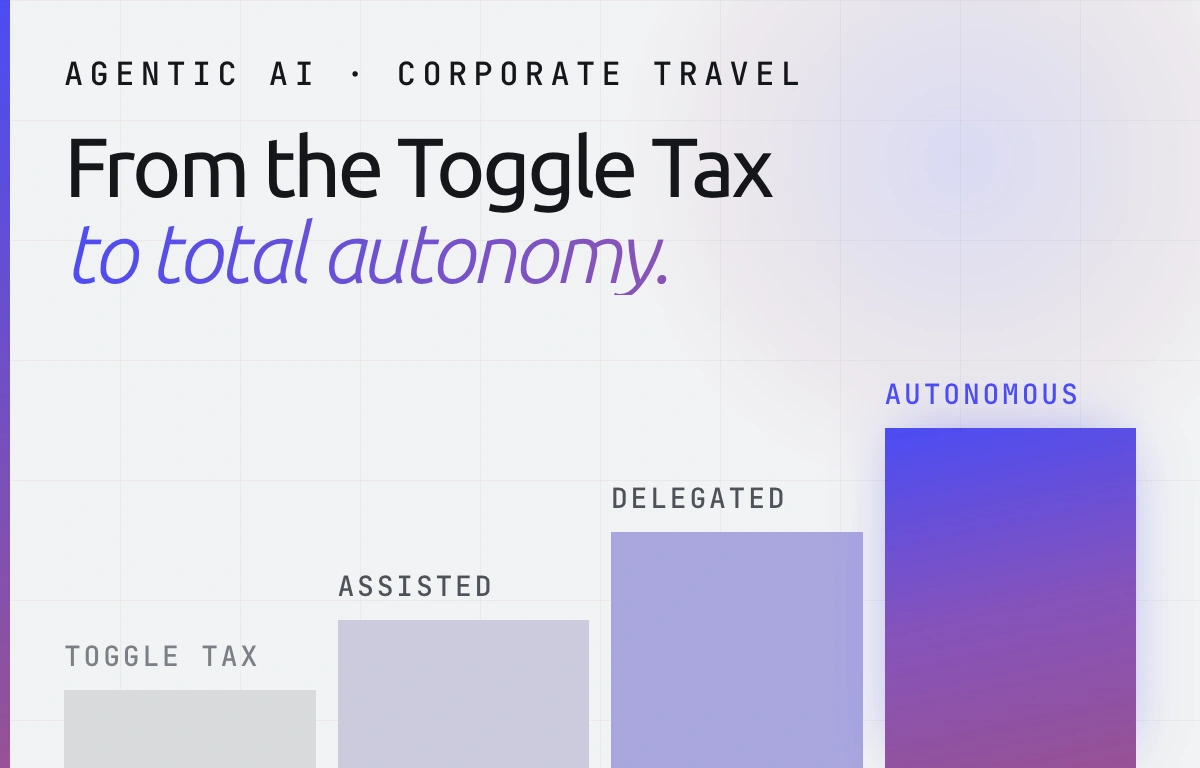
The Toggle Tax: answering one question means switching between a TMC booking tool, an expense platform, a card feed, a supplier portal and a compliance dashboard. The switching across 6+ disconnected systems compounds in hundreds of small moments where strategic people do administrative work.
Just 16% of travel buyers planned to add headcount in 2025 while 57% expected travel spending to rise. GBTA Business Travel Outlook Poll, February 2025.
Occupational fraud costs a median of $145,000 per case, and expense reimbursement schemes run a median of 18 months before detection. ACFE Report to the Nations, 2024.
Strategy dies in browser tabs. More dashboards will not close the gap. More capacity will.
This is what agentic AI expense management is for: not another view of the data, but the work done.
Each agent is configured with a focused remit, backed by advanced methods that guarantee the accuracy and reliability of every outcome. The framework doesn’t assist with T&E work. It does it.
A natural language brief, a schedule, or an event starts the work. No query syntax required.
The framework reasons over what is being asked and which data applies.
Live sources are queried simultaneously across your consolidated T&E estate.
Calculations run against your policy parameters, negotiated rates and business rules.
A direct, cited answer, plus the findings you did not ask for but need to see.
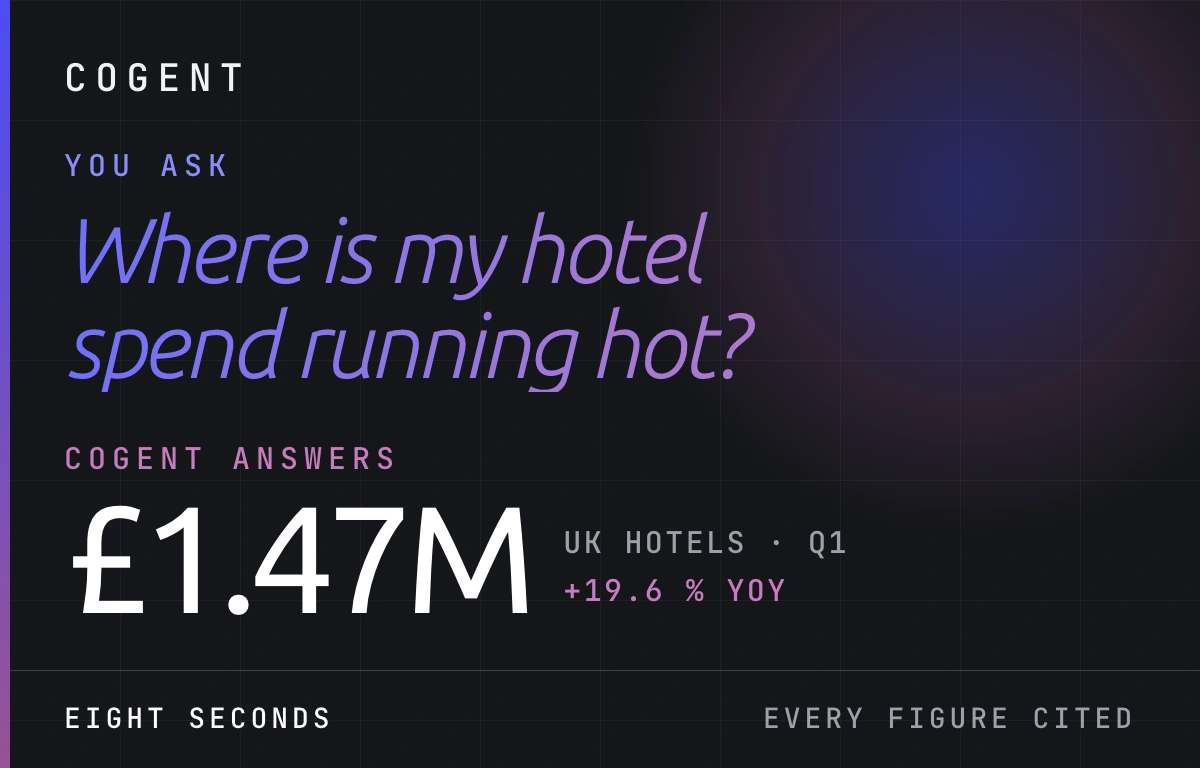
Which travellers drove the compliance dip in Q3, and what would fixing it save?
Reasoning over intent: compliance driver + savings estimate, scoped to Q3.
Querying live sources across the consolidated T&E estate.
Checking results against policy parameters and business rules.
14 travellers across EMEA account for 68% of the dip. Policy fix saves an estimated £210K annually.
Natural language, no query syntax
Data points across your consolidated estate
Cited, checked, ready to act on
PROOF · LIVE DEPLOYMENTS

01 · SCENARIO MODELLING
£600K–£800K
Global financial services · 20,000+ travellers
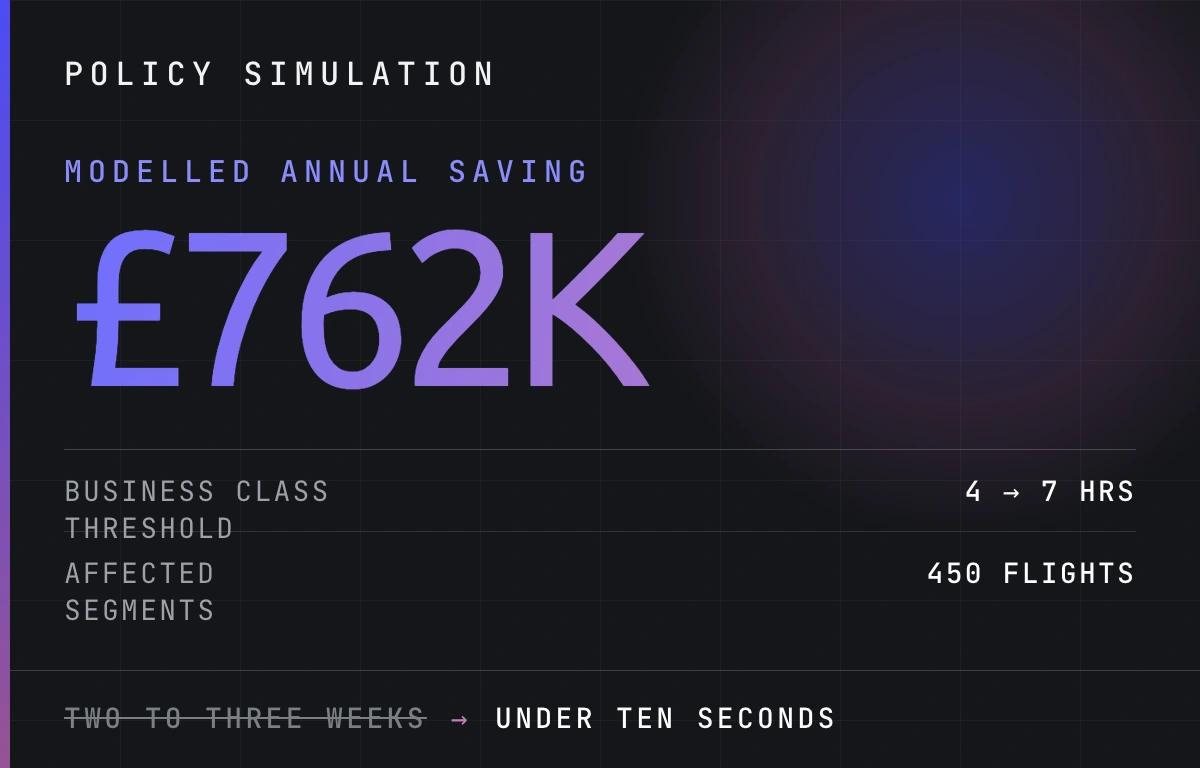
A business-class threshold change was modelled across roughly 450 affected flights, projecting £600K to £800K in annual savings. Manually: two to three weeks of analyst work. With Cogent: one brief, seconds, a finance-ready export with country-level breakdown.

02 · OFF-CHANNEL DETECTION
145 instances
Global pharmaceutical · 10,000+ travellers
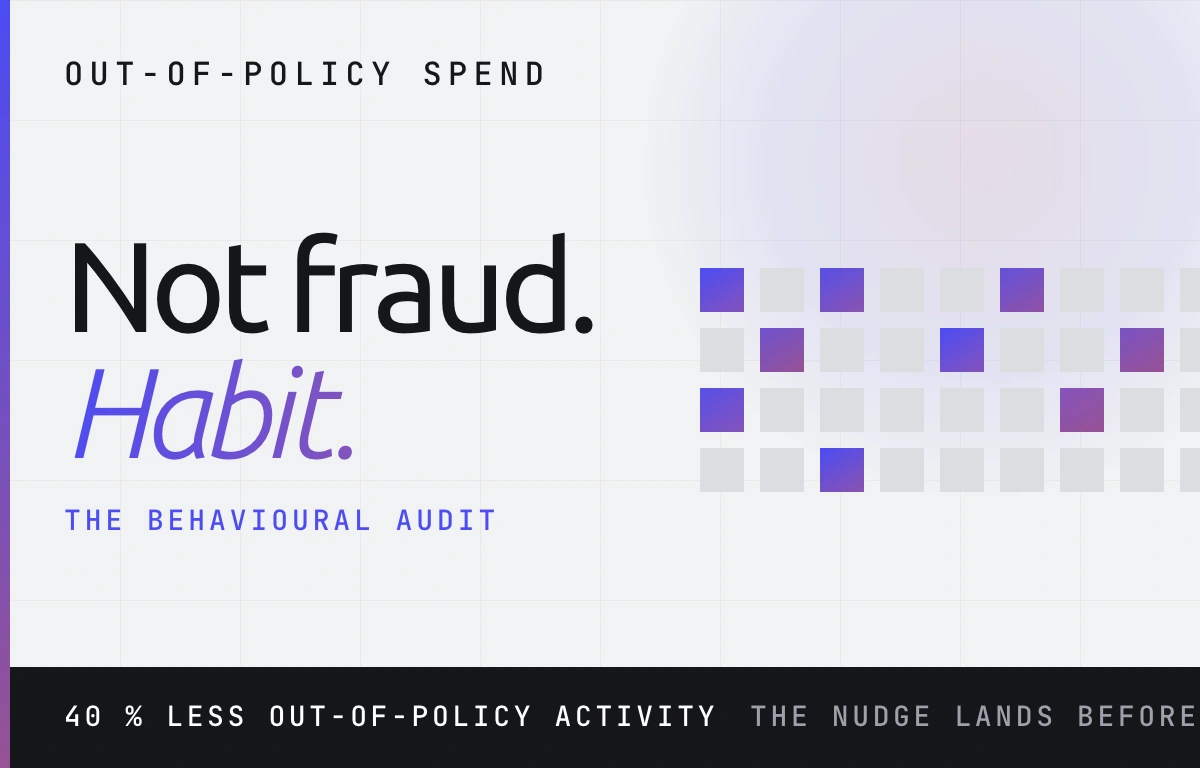
Expense fraud detection in one brief: 145 instances of off-channel spend surfaced, 80% traced to one department at one conference, protecting an estimated £45K to £55K in a single quarter.

03 · GROUND TRANSPORT BLIND SPOT
$4.44M
Global pharmaceutical · enterprise programme
One query exposed that 99.99% of rideshare spend carried no location data: a category most programmes cannot see at all. Cogent surfaced the blind spot in a single brief.

04 · ONE SOURCE OF TRUTH
3 → 1
Global biopharmaceutical · executive reporting
Three systems reported the same YTD air spend three ways. Cogent reconciled all three to one canonical, defensible figure, before the board meeting rather than during it.

05 · HIDDEN HIGH-VALUE TICKETS
17 tickets
Global biopharmaceutical · premium cabin audit
A search for premium tickets on one transatlantic route returned 2 results on the initial filter, then 15 more once the return leg was included: 17 tickets over $12,000 missed entirely.

“Every travel technology vendor promised us intelligence. PredictX is the only one that delivered autonomy. There is a significant difference between the two.”
HT
Head of Global Travel
Fortune 500 Manufacturing Group
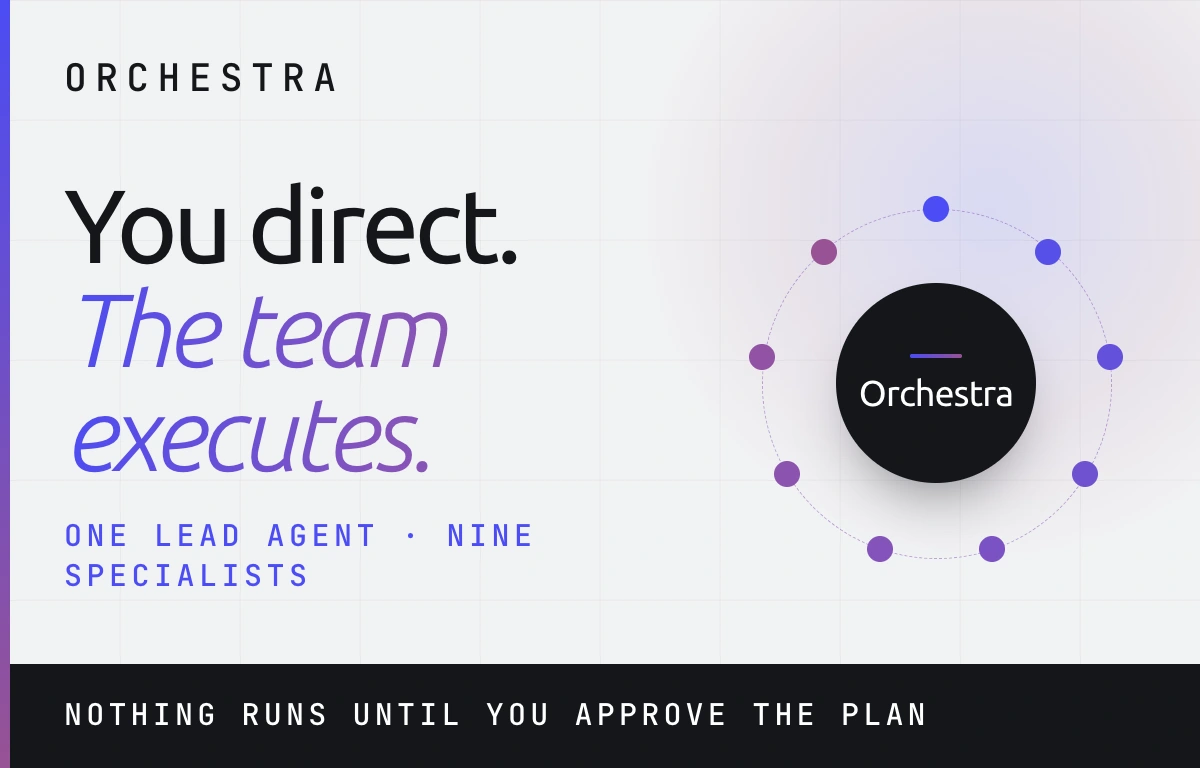
The Router Agent receives every query, classifies the intent, and creates a detailed plan across sub-agents. This is multi agent orchestration in practice.
Every brief is understood before anything runs, so compliance and sourcing questions take different paths.
Complex T&E work is broken into small, focused jobs with a clear owner, input and output.
Specialists run simultaneously, not in sequence; answers arrive in seconds rather than days.
Results return as one coherent, cited answer.
Specialist AI agents work in collaboration, each modelled after a real T&E role, not a generic model dressed up. Higher accuracy. Faster answers. Workflows that grow without adding headcount.
Interrogate consolidated booking, card, expense, HR and finance records at transaction level.
Read contracts, proposals and policies, with 100+ page PDF document comprehension.
Bring external fare, rate and supplier signal into the same analysis.
Continuous compliance scrutiny alongside DetectX, catching issues before reimbursement.
Agents do not just answer from your data; they work with it: a governed semantic layer over your whole estate, with retrieval augmented generation across your own documents, plus a toolkit including live web research. No rip and replace.
200+ maintained connectors: TMC, expense, card, booking tools, GDS, supplier, HR and General Ledger, unified.
Agents reach beyond your estate for live fares, capacity, routes and supplier signal.
When records disagree, a live booking record outranks a six-month-old PDF.
Every agent respects the requester's role-based access, to row and field level.
A confident-sounding answer is not the same as a correct one. The framework eliminates hallucinated answers through multi-step validation: every answer is checked, cross-referenced and grounded in your data before it surfaces, scored against your own rules rather than model confidence.
Data is cleaned and reconciled during ingestion, before the AI sees it.
A separate agent audits every output before release.
Surprising results pause for human review before a report is written.
Every answer records what was asked, what answered, traced to source.
Every answer shows why it was reached, not just what it concluded.
“The interface was never the hard part. The hard part sits underneath: an independent validation layer between the model and the answer. That is what lets an enterprise delegate whole T&E workflows, not just questions.”
Agentic AI is already running these workflows on this framework, from expense management automation to full sourcing cycles.
Automated expense reporting: compose, format and deliver auditable reports on demand, every figure traceable to its source query.
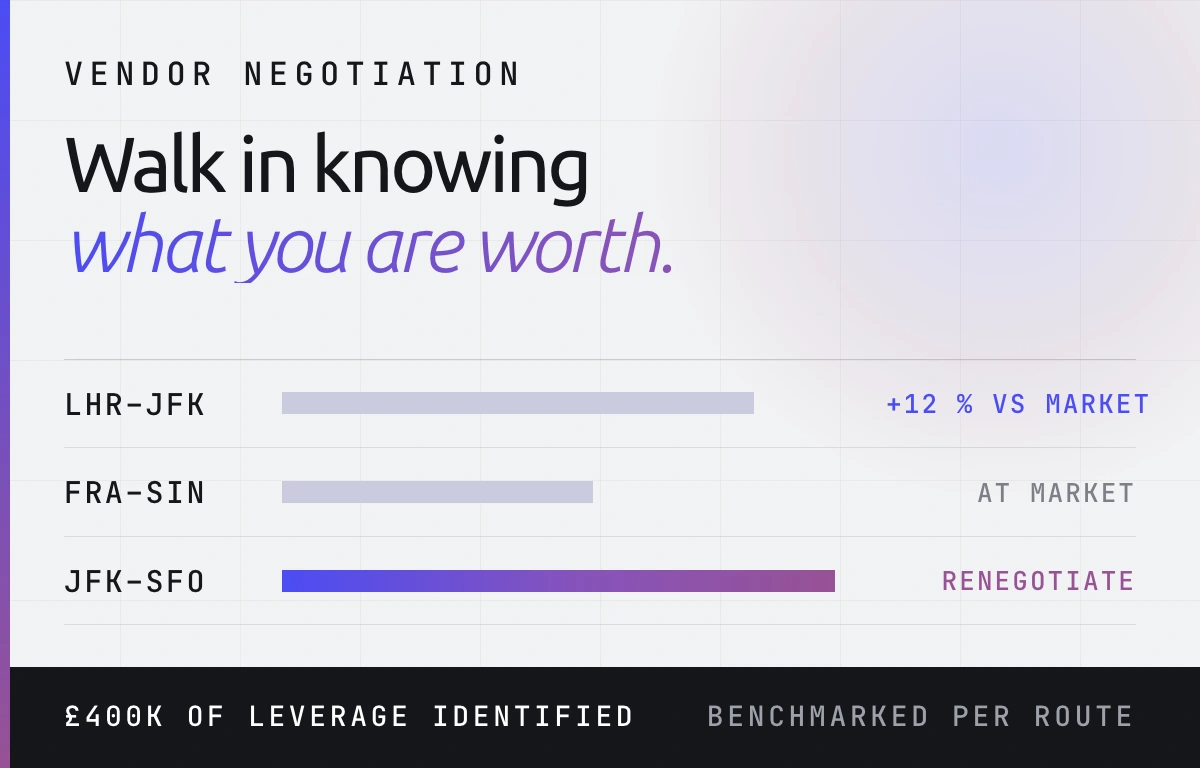
Build data-backed negotiation briefs from contract terms, historical spend and live market signal.
Q3 travel spend, board-ready.
Report compiled: 4 regions, every figure cited to source.
Continuous auditing: agents autonomously scan live data and surface opportunities with action plans, including T&E leakage detection.
Natural-language interrogation of every spend dimension, including forecasting and budget variance, down to entity-level travel spend analytics, with the working shown.
Procurement analytics, sourcing, supplier evaluation, RFP automation and contract execution run as delegated agent jobs.
Chain agents into repeatable jobs, triggered on schedule, on event, or on demand from any connected interface.
BUILT ON THIS FRAMEWORK
The framework ships inside two products and one free library.
AI T&E reporting and analysis
Ask in plain language
Every figure cited to source
Suggested next steps with every answer
The AI agent team for travel and expense
An AI agent team, not a chatbot
Human approval gates on every plan
Consultant-grade deliverables, exportable
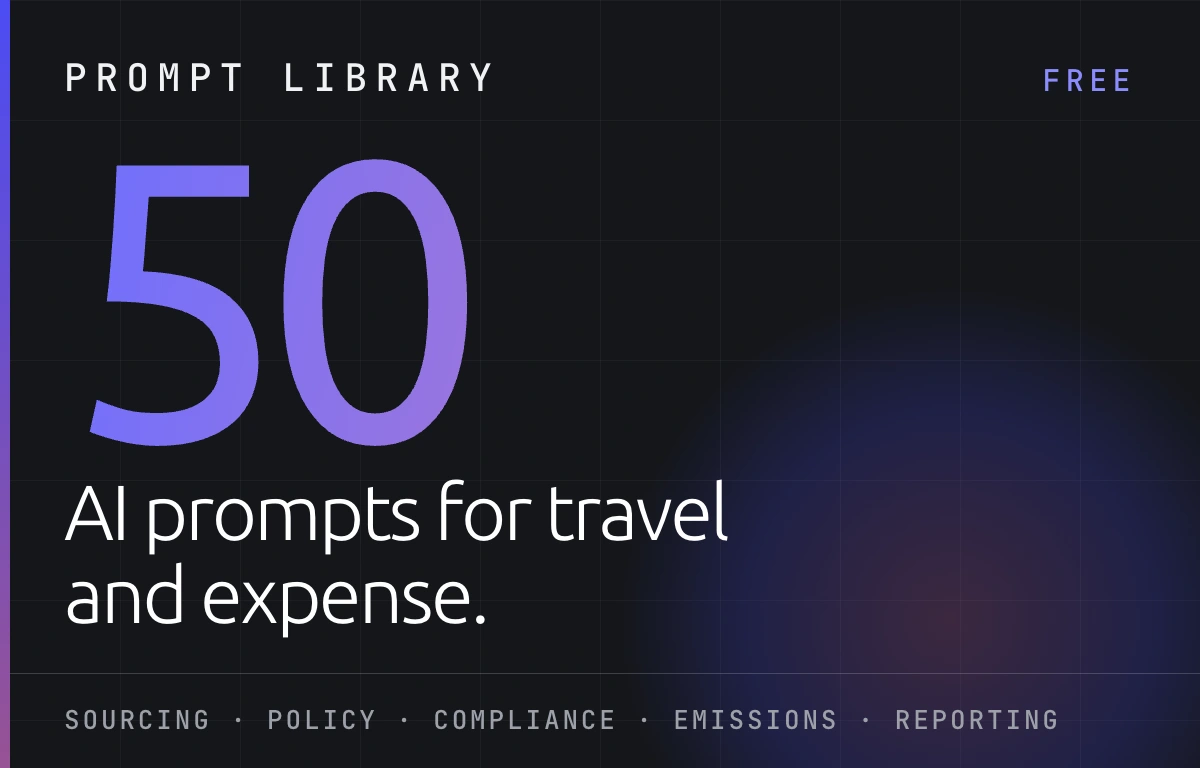
50 AI prompts for travel and expense
Ten categories, copy and run
Starter pack for your first week
Free, no gate
AI governance is built in by design, not by policy document. It augments your team’s judgement under human oversight; it does not replace it. You delegate the workload, not the authority, and every workflow ships enterprise-ready.
You define which decisions agents take autonomously and which route to a named human.
Handoff points are explicit, with clear done criteria.
An AI audit trail with continuous controls monitoring: audit exactly what ran, when and why.
ISO 27001:2017, PCI-DSS, Cyber Essentials, with GDPR compliance and data residency options.
Tenant data fully isolated at every layer; zero cross-tenant access by design.
SSO, role-based permissions inherited from your IdP, enforced to row and field level.
Data encrypted in transit and at rest, across every connector and every tenant.
Every agent action, query and response logged, with DPA available on request.
Continuous audit trails and exception evidence for FCPA, OFAC and Sarbanes-Oxley review.
Each task routes to the right model for cost, latency and accuracy; no vendor lock-in.
Agents, tools and permissions managed from one control plane, with first-class logging and tracing.
Dashboards are good at monitoring known KPIs; embedded copilots are good at in-flow tasks inside their host platform. The decision is which job you are hiring for. Follow one question through each era: “Which travellers drove the compliance dip, and what would fixing it save?”
| Dashboard | Copilot | The Cogent AI Framework | |
|---|---|---|---|
| Answers | What happened? | What should I do? | What got done? |
| A brand-new question | BI request, rebuild | From host-system data | Planned, executed, validated |
| Data reach | Modelled in advance | One platform | Consolidated, governed, 200+ sources |
| Validation | A human checks the chart | Model confidence | Business-rule evals, independent validation agent |
| Deliverable | A chart to interpret | An answer to act on | The finished, cited report |
| Your role | Analyst | Operator | Director |
The direction of travel is set: Gartner projects that 40% of enterprise applications will ship task-specific AI agents by the end of 2026, up from under 5% in 2025. Source: Gartner, August 2025.
Every decision starts from validated intelligence instead of another meeting.
WHY WE BUILT THIS

I have watched travel and expense teams live inside the same contradiction for twenty years: more data than almost any function in the company, and less capacity to act on it. The problem was never the data. It was the speed at which decisions could be made from it.
And the real potential of AI is not in taking over the jobs people already do. It is in doing the work that is not being done: the work that was too expensive, that needed too many people, that never made it off the list. That is what we built the framework for. Not a faster dashboard. A workforce.
Keesup Choe · CEO, PredictX
RELATED RESOURCES