

Corporate travel sustainability on the same data as your spend.
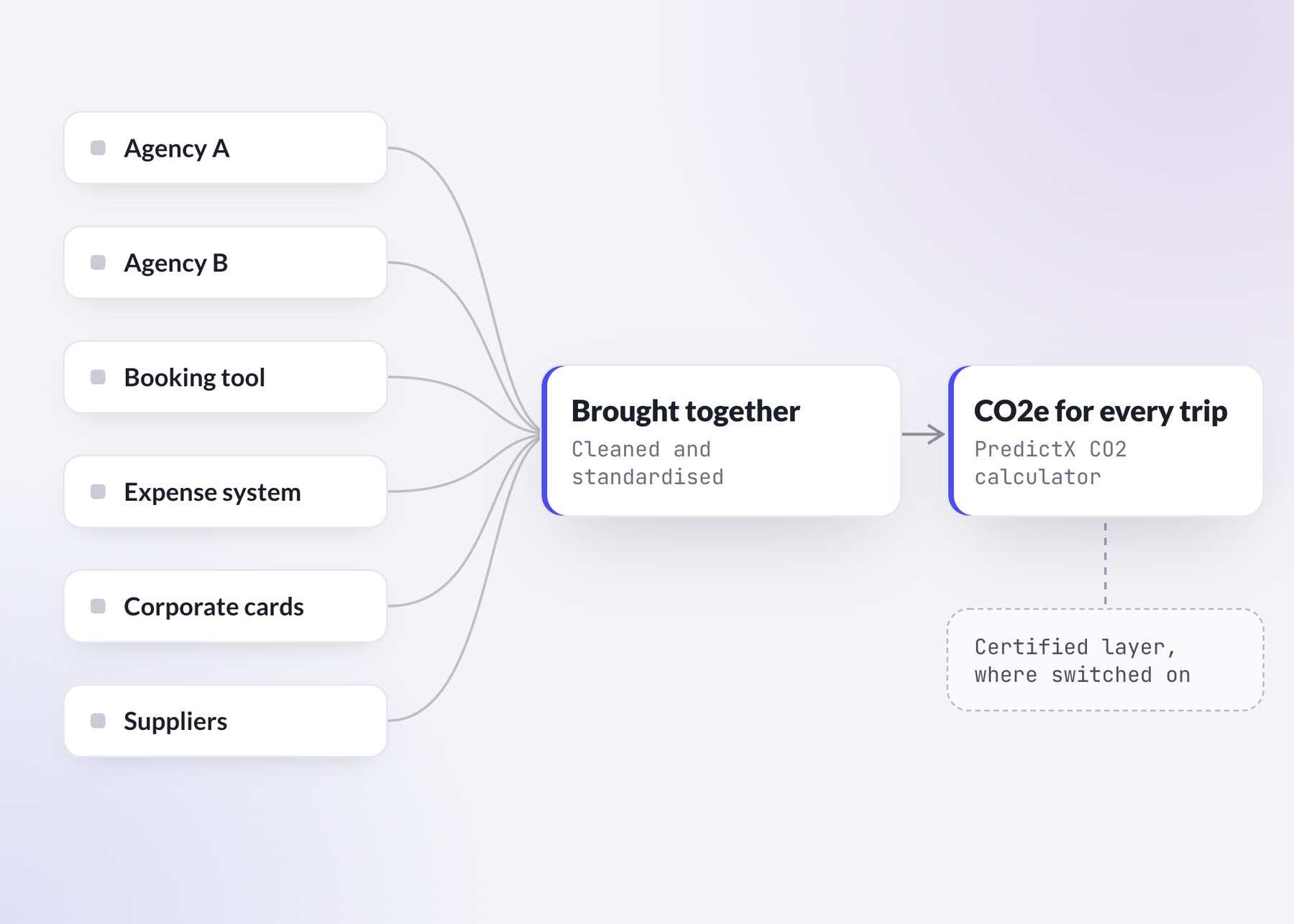
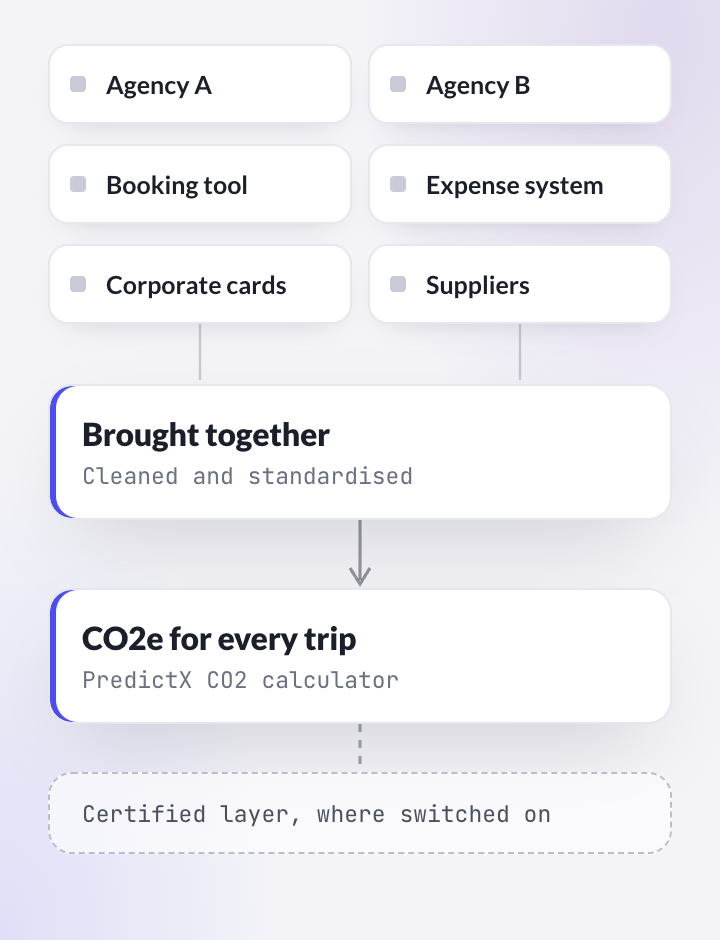
The PredictX Sustainability module is travel emissions reporting software. It calculates the emissions of every business trip by one method, from the records your agencies, booking tools and expense systems already hold.
200+ travel data sources, connected by PredictX Data & Reporting winner at the Business Travel Awards Europe 2025
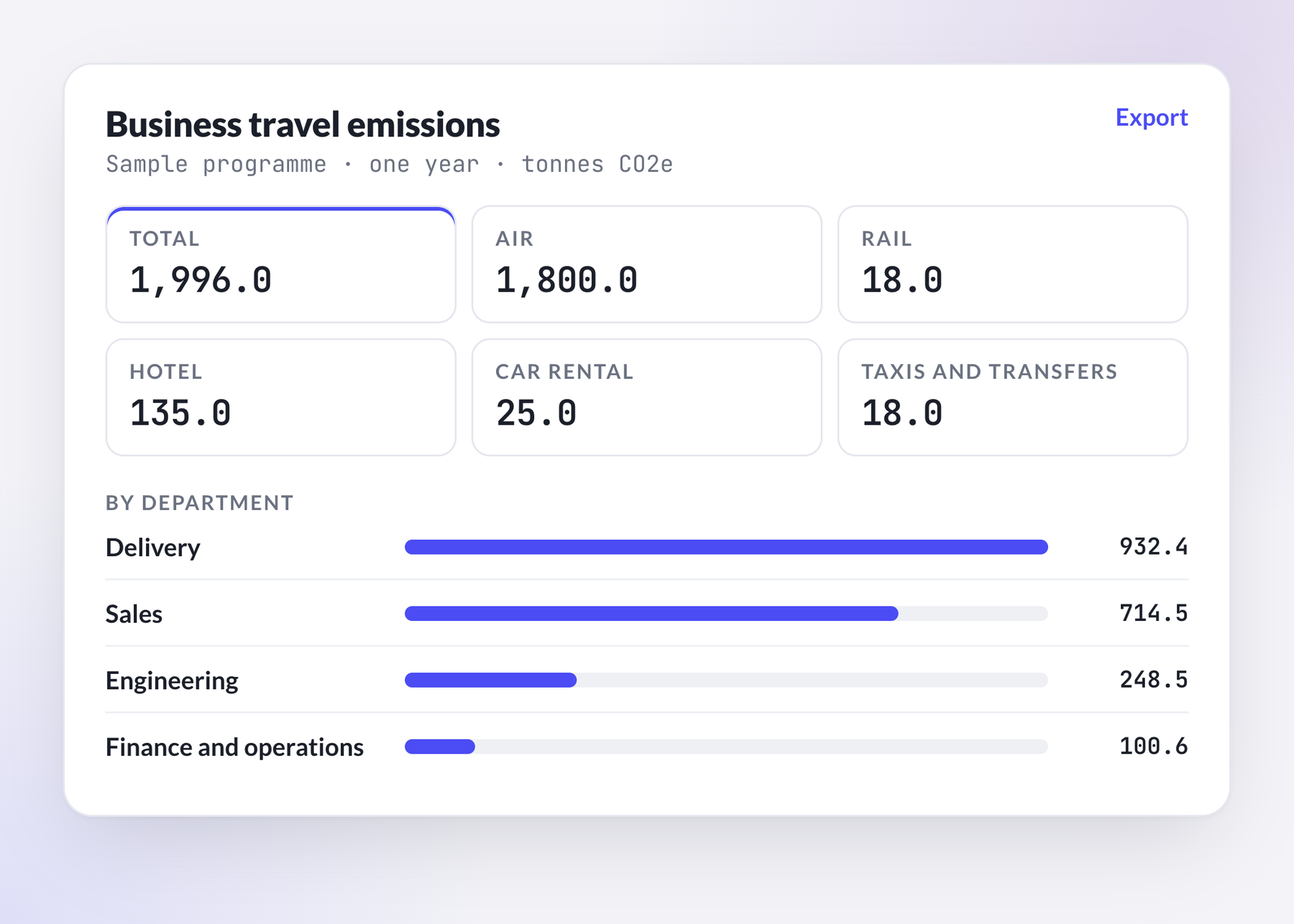
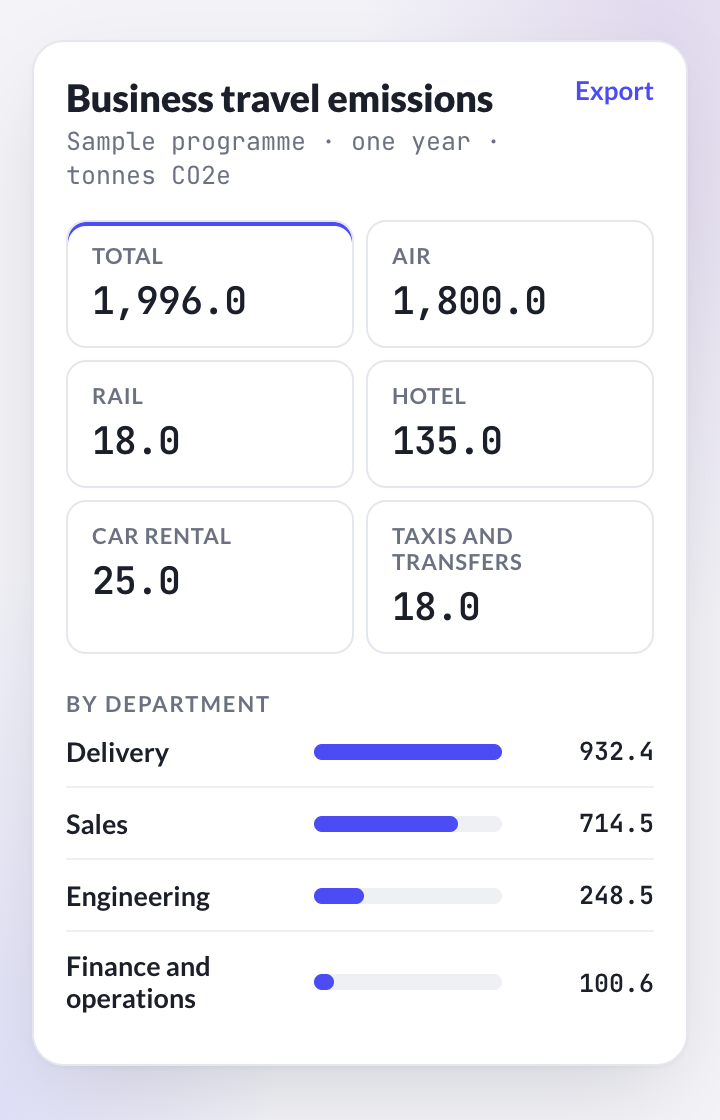
Sample data. Business travel emissions for a sample programme over one year, in tonnes CO2e. Total 1,996.0. By mode: air 1,800.0; rail 18.0; hotel 135.0; car rental 25.0; taxis and transfers 18.0. By department: Delivery 932.4; Sales 714.5; Engineering 248.5; Finance and operations 100.6. An Export button sits at the top right.
Every report counts its own slice. Nobody counts the whole.
One agency's CO2 report covers the flights it booked. A second agency uses a different method.
One large global consultancy's published travel emissions were based solely on air mileage. Adding hotel and car rental data, plus internal calculations for rail and black car, gave it one emissions model it could cut by business area and project code, as the consultancy's client story describes.
Rail and taxis sit in expense claims, hotels booked direct sit in card data and somebody joins it all in a spreadsheet. None of this is carelessness: each tool was built to report its own bookings, not your whole programme.
When the assurance work starts, nobody expects a perfect number. They expect to see where each figure came from.
How do you report travel emissions when bookings come from more than one agency?
Bring together the data you already have, then calculate. The Sustainability module takes booking, expense, card and supplier data and works out the emissions of every trip in CO2e (carbon dioxide equivalent) the same way, whichever agency or system it came from.
Your disclosure covers all of your business travel, so the data behind it should too.
Which software tracks travel emissions across flights, rail, hotels and car hire?
The Sustainability module tracks business travel emissions across flights, rail, hotels, car hire, taxis and transfers in one PredictX dashboard, each mode set against the year before.
The International Council on Clean Transportation found that a premium-class passenger emitted 2.6 to 4.3 times more CO2 per kilometre than an economy passenger, depending on aircraft class, in its 2020 study of commercial aviation emissions.
One screen answers the question several reports used to.
- Breakdowns: department, business unit, traveller, trip reason and project code.
- Cabin class: shown separately, because the seat changes the footprint.
Can you trace each reported tonne back to the trip behind it?
Yes. PredictX can trace any figure in the Sustainability module back to its trip when you ask, for example when an assurer wants to know where a number came from.
A test for today's report: pick one tonne in last year's business travel total and ask which trip it came from. If answering means rebuilding the total by hand, the trail is in someone's spreadsheet, not in the data.
The calculation method, on request: PredictX confirms which one produced a figure for your assurance review.
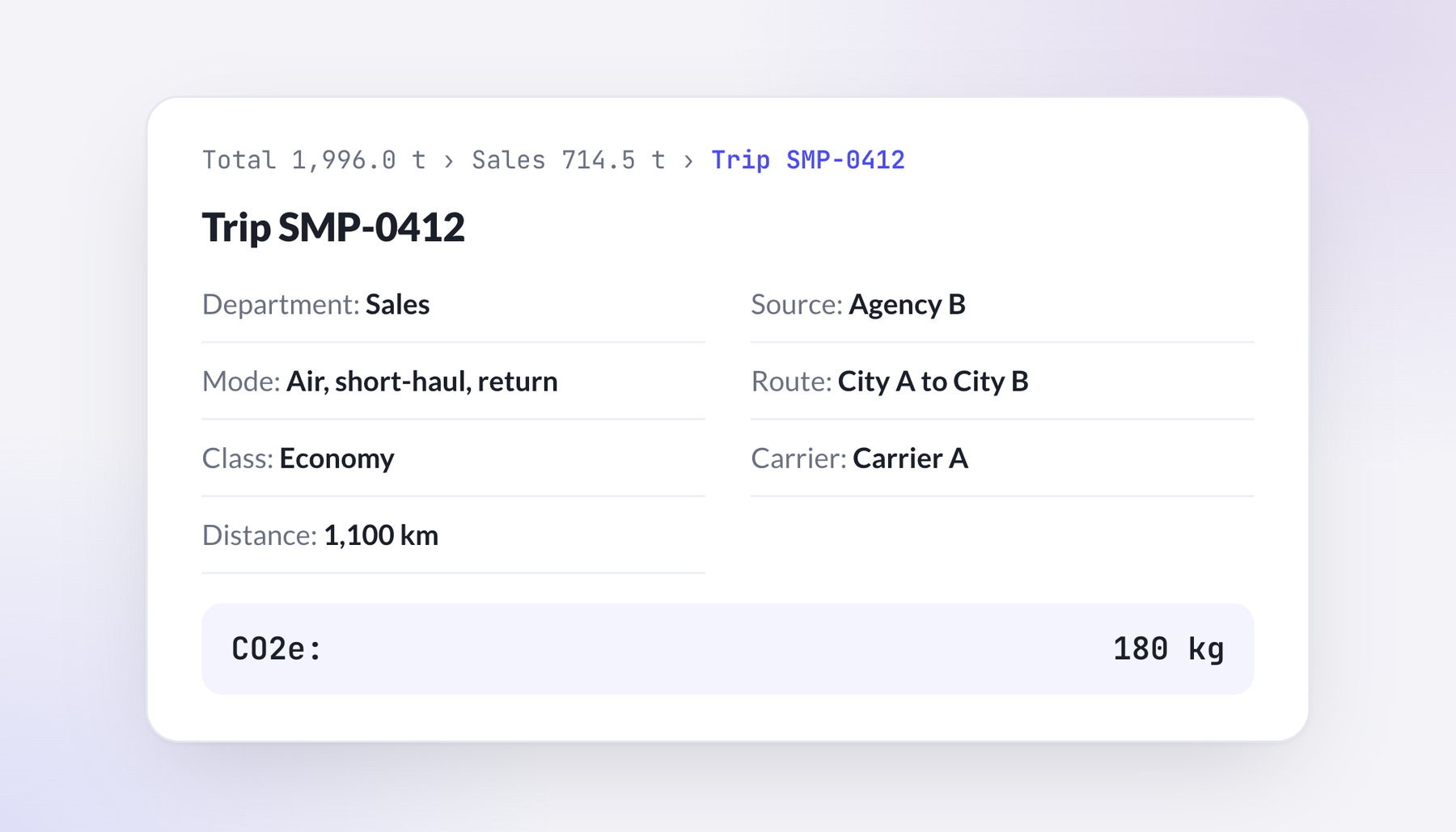
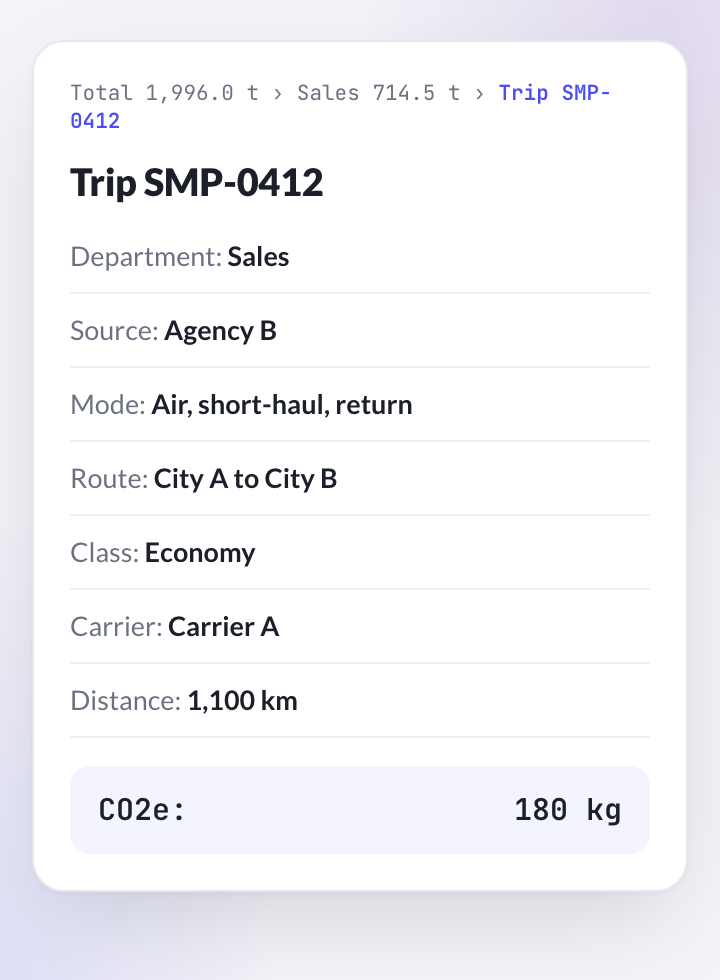
Sample data. Trip SMP-0412, opened from the total of 1,996.0 tonnes through Sales, 714.5 tonnes. Department: Sales. Source: Agency B. Mode: air, short-haul, return. Route: City A to City B. Class: economy. Carrier: Carrier A. Distance: 1,100 kilometres. CO2e: 180 kilograms.
When would you switch on SQUAKE's certified calculation?
When you want each figure's calculation certified, for example ahead of assurance. SQUAKE, PredictX's CO2e calculation partner, provides the certified calculation as an optional layer, switched on per client, for air, rail, road and hotel stays.
- SQUAKE's certified calculation is aligned with the GHG Protocol and ISO 14083.
- Without the certified layer: PredictX's own calculator still covers every trip with one method.
Certified figures sit in the same PredictX dashboards.
How do you set carbon budgets by department and see who is over?
Give each department or business area a carbon budget for the year. The Sustainability module tracks emissions against it as data arrives, so you see who is over. Emissions forecasting tells you where each budget will land against the reduction targets your leadership has already set.
Sample programme, one year: Sales is 64.5 t CO2e over its carbon budget, and the other 3 departments are within.
Overspends show up mid‑year, not in the year-end report.
What does an internal carbon price add to a travel decision?
An internal carbon price is a cost put on every tonne of travel emissions, so the carbon cost of a trip sits beside its fare. In the Sustainability module you set the price, then compare carbon cost across departments.
Sample data: the carbon cost of a year of travel at £50 a tonne.
How much CO2e would you save by moving short‑haul flights to rail?
It depends on your routes and how many flights you move. The Sustainability module sets air and rail emissions side by side for the same route, using your own travel, so you see the CO2e moving those flights would avoid before you change policy.
Rail is growing: passenger travel with the EU's main rail operators reached 443 billion passenger-kilometres in 2024, up 5.8% on 2023, according to Eurostat's 2024 figures, released October 2025.
Can you ask your travel data which departments emitted the most CO2 this quarter?
Yes. Cogent, the agentic AI underneath every PredictX product, answers questions about your travel emissions in plain language. Because emissions sit on the same records as spend, the travel manager, finance and the sustainability lead get answers that agree.
"Which departments exceeded their carbon budget this quarter?"
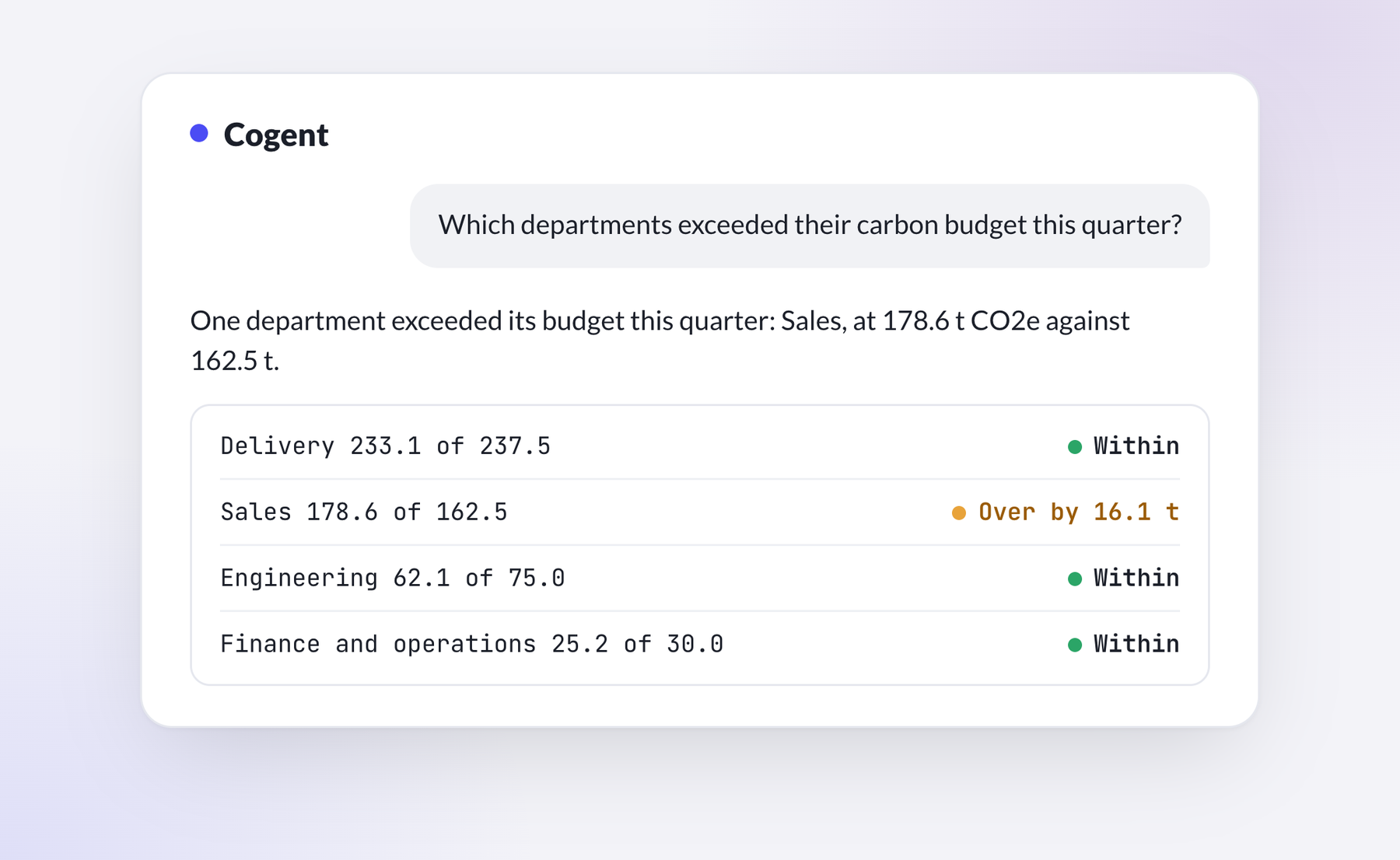
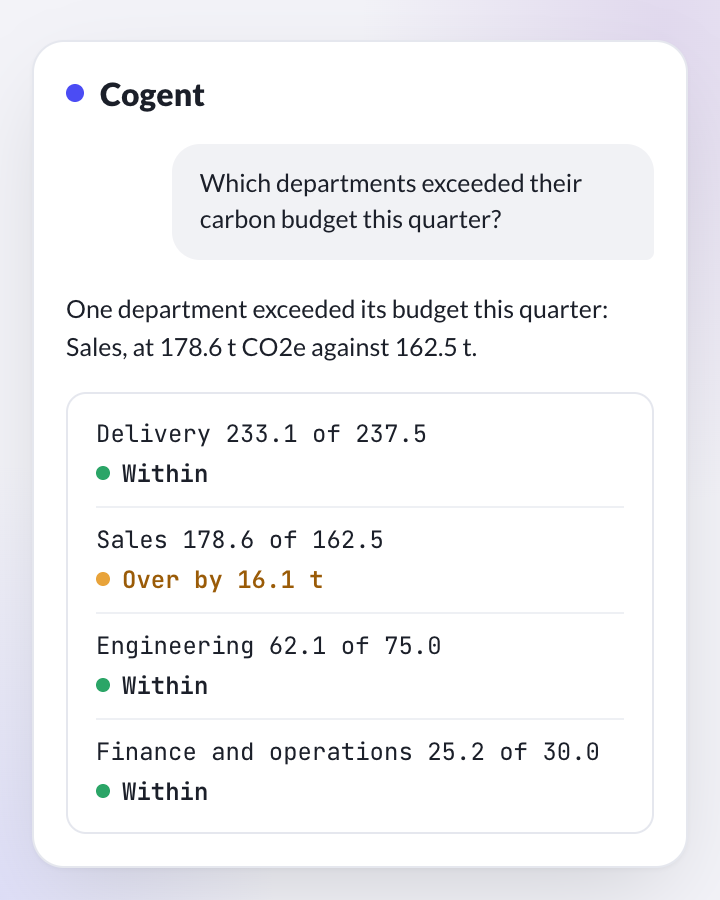
Sample quarter. Cogent's answer to the question above: one department exceeded its budget this quarter, Sales, at 178.6 tonnes CO2e against 162.5. Delivery, 233.1 of 237.5, within. Sales, 178.6 of 162.5, over by 16.1 tonnes. Engineering, 62.1 of 75.0, within. Finance and operations, 25.2 of 30.0, within.
Where does the module fit beside your agency's report and your carbon platform?
Keep the agency's report and the carbon accounting platform: the Sustainability module sits between them and supplies the travel line the carbon platform depends on. PredictX does not sell travel, so every agency's bookings are reported on the same basis.
If carbon is the only thing you need measured, a specialist carbon tool may go further. The module is built for sustainable corporate travel: emissions answered beside cost, policy and suppliers. It also adds lower-carbon supplier criteria when you refine RFPs and contracts, alongside T&E sourcing analytics.
Questions about corporate travel sustainability reporting
Why do different tools give different CO2 figures for the same flight?
Because each tool applies its own method and factors to the same trip, and each sees only its own bookings. The PredictX Sustainability module applies one calculation to every trip in your consolidated data, whichever agency or system it came from, so figures from different sources add up to one total.
How is business travel CO2e calculated in the Sustainability module?
PredictX's CO2 calculator works out the CO2e of each trip from its travel record, by one method. Clients who switch on the optional certified layer have CO2e for air, rail, road and hotel stays calculated with recognised methods. The layer supports several, and a client that wants its own or another supported method agrees it with PredictX at set-up.
Is the CO2e calculation certified?
The certified calculation comes from SQUAKE, PredictX's CO2e calculation partner, and applies only to clients who switch that layer on. PredictX's own calculator covers every client with one method, but its figures are not presented as externally certified. Both appear in the same dashboards.
Our travel agency already gives us a CO2 report. Why would we need more?
Keep the agency's report: it covers the trips that agency booked. Your business travel total also includes any second agency, rail and taxis claimed on expenses, and hotels booked direct. PredictX brings those together and calculates each trip by one method, so the total covers every trip you connect.
Does the Sustainability module replace our carbon accounting platform?
No. A carbon accounting platform records every scope of your footprint, and under the GHG Protocol business travel is Scope 3 category 6 of 15. The Sustainability module is travel emissions reporting software: it produces that category's figures from the travel and expense data PredictX consolidates, in reports you can export.
Who has to report business travel emissions under CSRD?
As at October 2026, the EU's Corporate Sustainability Reporting Directive (CSRD), narrowed in February 2026, applies to companies with more than 1,000 employees and over €450 million in net turnover. Its revised European Sustainability Reporting Standards (ESRS), published as Delegated Regulation (EU) 2026/1563 in September 2026 and applying to financial years starting on or after 1 January 2027, ask for emissions from each significant Scope 3 category; business travel is category 6. In the UK, Streamlined Energy and Carbon Reporting (SECR) is separate.
How current are the emissions figures?
Figures update as your booking, expense and card data arrives, so they are as current as your feeds. A trip's emissions are worked out once its record lands, rather than at the end of a reporting cycle. Cogent answers questions on that current data in real time, so a question asked today reflects every trip received so far.
Get more out of PredictX
PredictX can test a lower-carbon policy first, answer questions about your programme in plain language and run whole projects you approve.
Meridian: travel policy, tested
Test a lower-carbon rule on your own travel data before it reaches travellers.
- CO2 beside cost in every policy scenario
- Finds the cheapest rules under a CO2 ceiling
- Weighs rail fares against the CO2 saved
Cogent: ask in plain language
Ask about spend and compliance in the same plain words you use for emissions.
- Emissions by route, with no query to write
- Spend against budget, entity by entity
- Every figure traced to its source
Orchestra: your AI agent team
Hand a sustainability project to an AI agent team and approve the plan before it runs.
- Specialist agents report to a project manager
- Specialists cross-check each other's findings
- An appendix traces each claim to its source
See how your programme would add up, trip by trip.
In a demonstration shaped to your programme, we walk through how the Sustainability module would bring together data from your agencies, expense system and cards.