

Strategic sourcing software that shows how each score was reached.
Rubicon by PredictX is a sourcing platform for procurement teams that evaluates supplier responses. Import whatever suppliers sent, wherever the event ran, Rubicon included: it reads every bid on the same basis, narrative answers beside the price, and traces each insight back to the response it came from.
Rubicon by PredictX is a sourcing platform for procurement teams. It evaluates whatever suppliers sent, wherever the event ran.
Increase team capacity by up to 80% with Rubicon. Built by PredictX, in London since 2012.
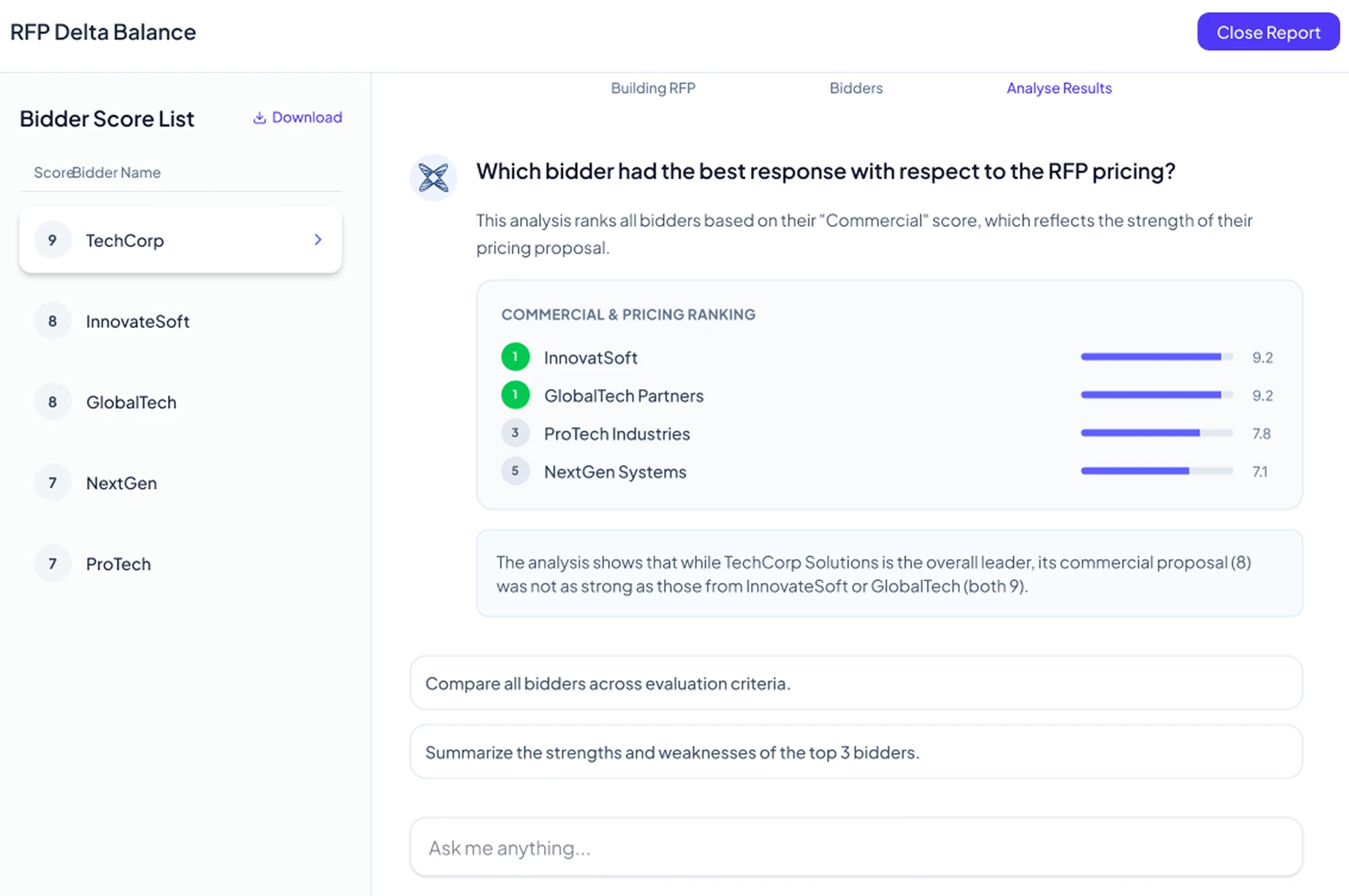
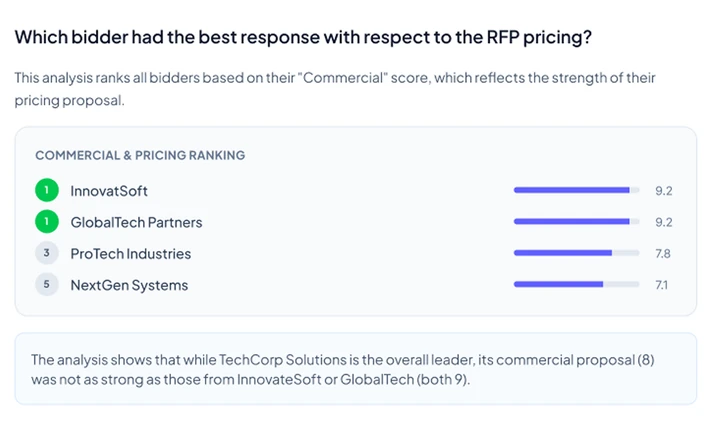
Spreadsheets record the score. They do not record why.
Responses to tenders and RFPs arrive as PDFs, spreadsheets and slide decks. Someone retypes the prices, and the long answers get read once, by whoever has the time.
Supplier responses arrive as PDFs, spreadsheets and slide decks. Someone retypes the prices, and the long answers get read once, by whoever has the time.
The US Government Accountability Office's bid protest report for fiscal year 2025 lists unreasonable technical evaluation first among the most prevalent reasons it sustained US federal bid protests.
Then a losing bidder asks for a debrief, or audit asks why the panel chose who it chose. The score is in the sheet. The reasons are in someone's notes.
The question comes after the award. The answer has to exist before it.
Do you have to run the sourcing event inside Rubicon?
No. Bring in the responses from wherever the event ran, in your procurement suite, by email or anywhere else, or run the event in Rubicon. Either way, the same sourcing software evaluates every response.
No. Bring in the responses from wherever the event ran, or run it in Rubicon. Either way, Rubicon evaluates every response.
Inside a Rubicon event, it contacts the suppliers too: clarification requests, best-and-final invitations to the suppliers you choose, and award and regret letters you see before anything goes out. When the best bids are close, you can open a reverse auction there.
Wherever the event runs, the decision stays yours.
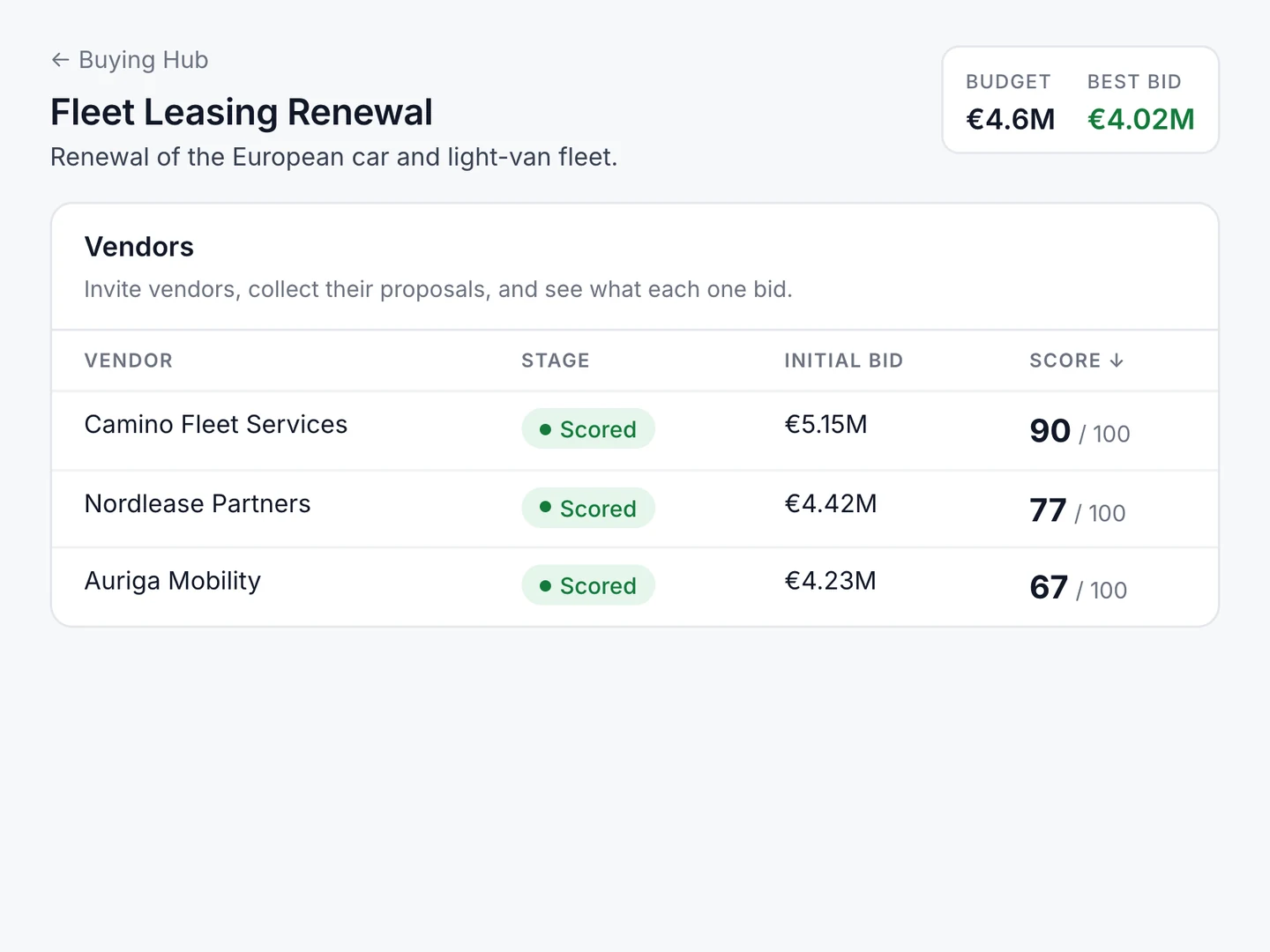
Rubicon demo data · Vendors › Scored
How does AI evaluate supplier responses to an RFP?
Rubicon applies the criteria and weights your team set to every supplier response, so each bidder is scored against the same questions in the same way. It reads what sits beyond the bid sheet as well as the price: narrative answers, attachments and the terms suppliers add.
Rubicon applies your team's criteria and weights to every supplier response, reading the narrative answers, attachments and added terms as well as the price.
The longest attachment gets the same reading as the price line.
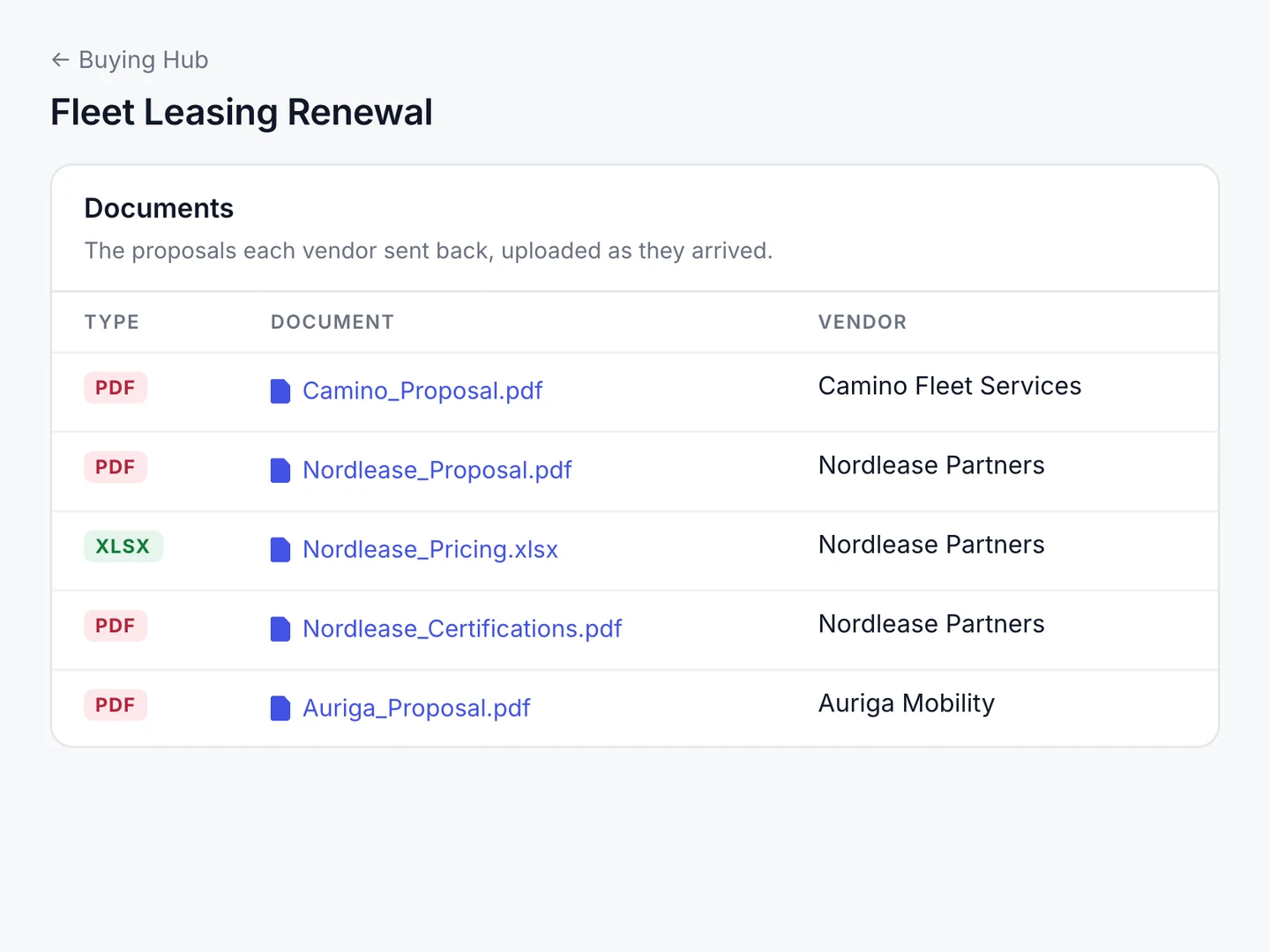
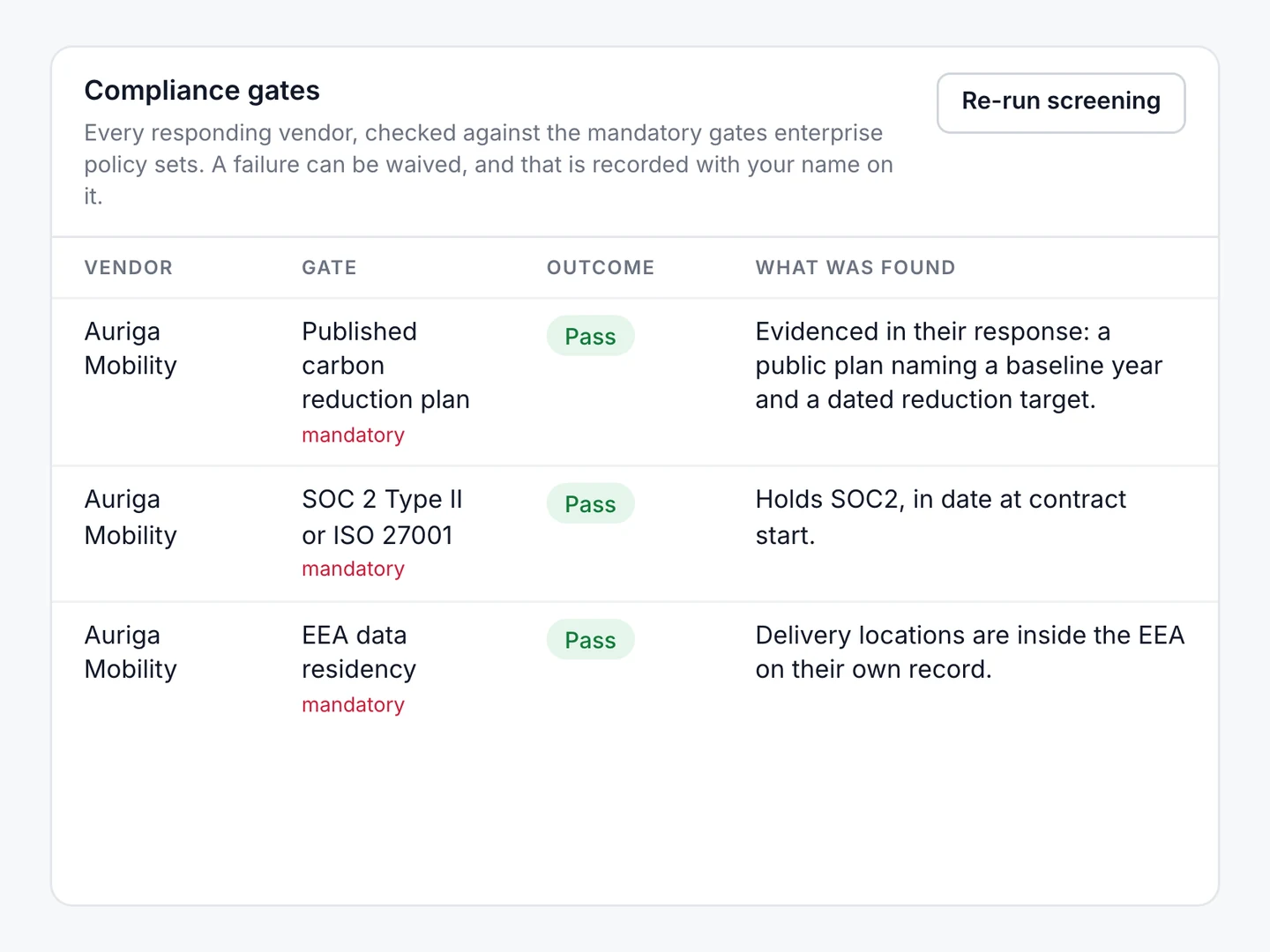
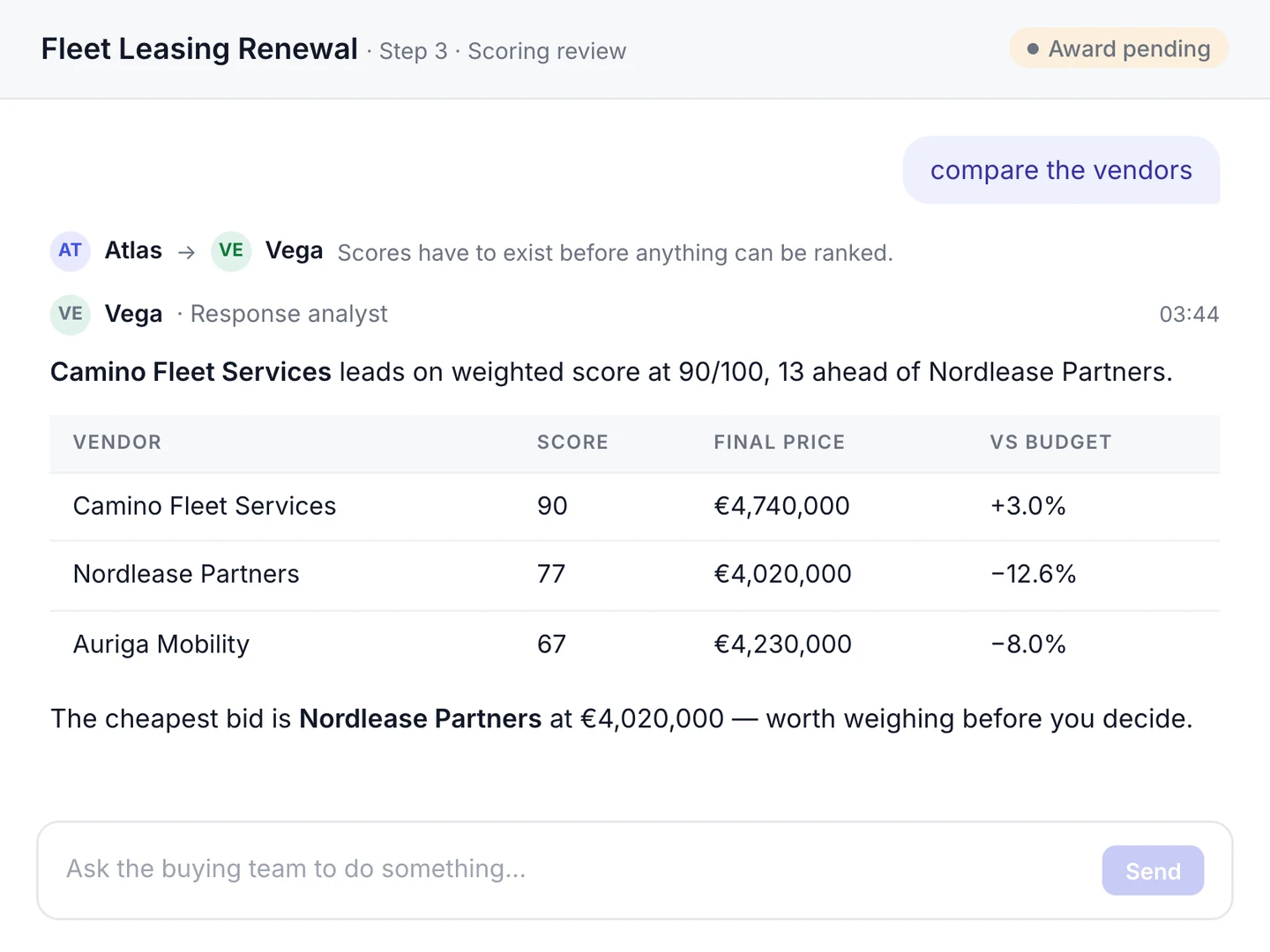
- The same criteria for every bidder.
- Any format: documents, spreadsheets and presentations, as suppliers sent them.
- Exceptions, gaps and risks flagged: each tied to the response it came from.
- Questions in plain language: across every response, such as which suppliers subcontract any of the work.
How do you compare supplier bids that arrive in different formats?
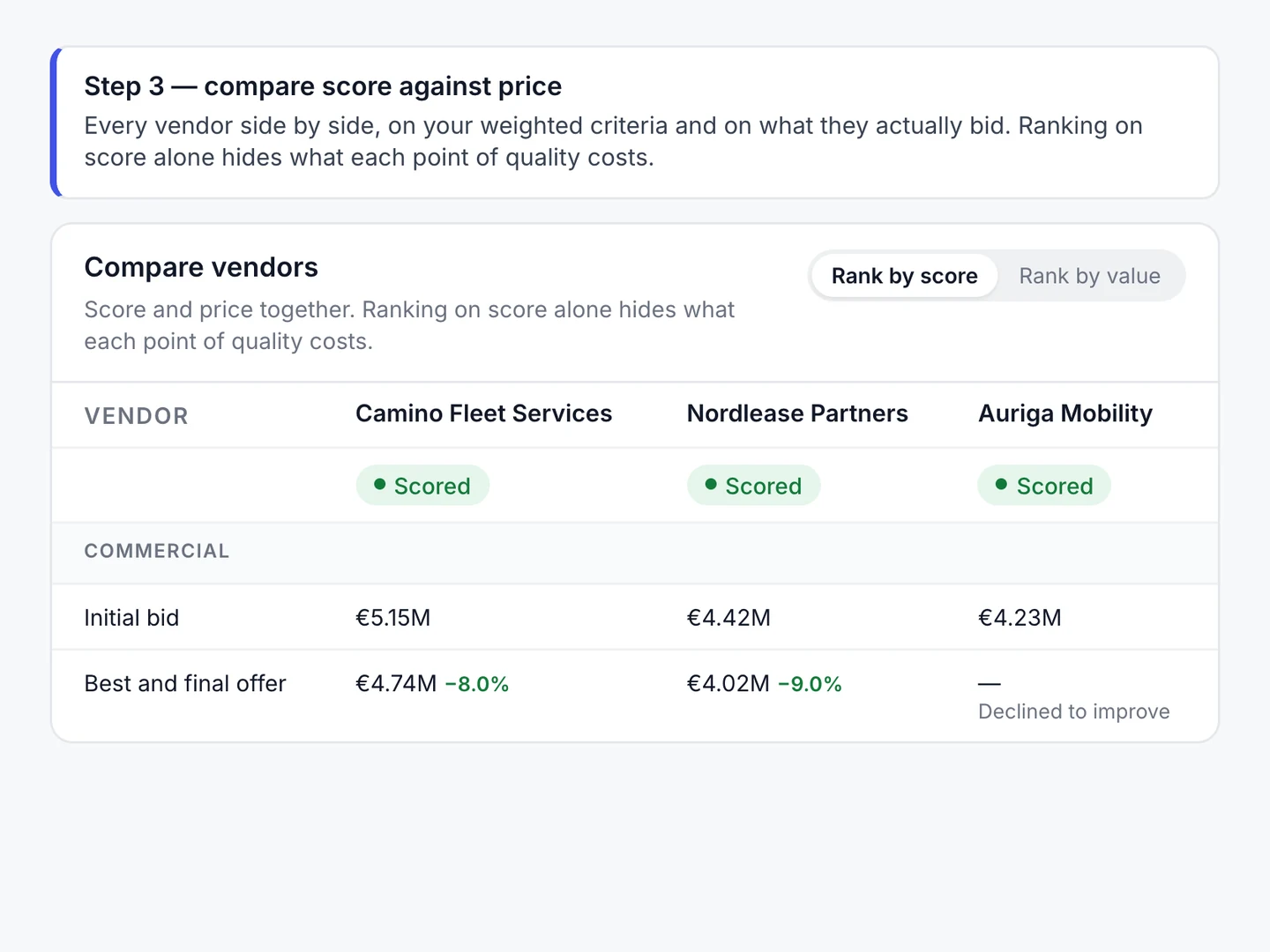
Rubicon puts the pricing, terms and written answers from every bid, in any format, side by side on the same basis. The sample below shows how much your weights decide.
Rubicon puts the pricing, terms and written answers from every bid, in any format, side by side. The sample below shows how much your weights decide.
Weight price at 60% and Supplier B ranks first, on 85.0.
Sample evaluation: a facilities services tender, 4 sites, 4 suppliers
- Weights
- price 40%, service quality 25%, mobilisation 20%, contract terms 15%
- Supplier C
- 80.0 out of 100; annual price $1,310,000
- Supplier B
- 77.0; annual price $1,180,000, the lowest; 2 flags, including a liability cap of 3 months' fees
- Supplier A
- 73.0; annual price $1,240,000
- Supplier D
- 67.0; annual price $1,265,000; flagged: no mobilisation plan in the response
How do you show an auditor or a losing bidder how each score was reached?
Each score opens onto its evidence: Rubicon backs every recommendation with the scoring criteria and the supplier responses it rests on, and every insight traces back to the original supplier response. The decision can be defended to audit, to legal or to a bidder who lost.
Each score opens onto its evidence: the criteria and the supplier response behind it. The decision can be defended to audit, to legal or to a bidder who lost.
Rubicon works as an AI procurement co-pilot. It recommends. Your panel makes the award.
When a losing bidder asks why, the reasons sit beside each score, tied to their own response.
Rubicon runs on Cogent, the AI engine behind the PredictX platform, and shares that platform's security controls.
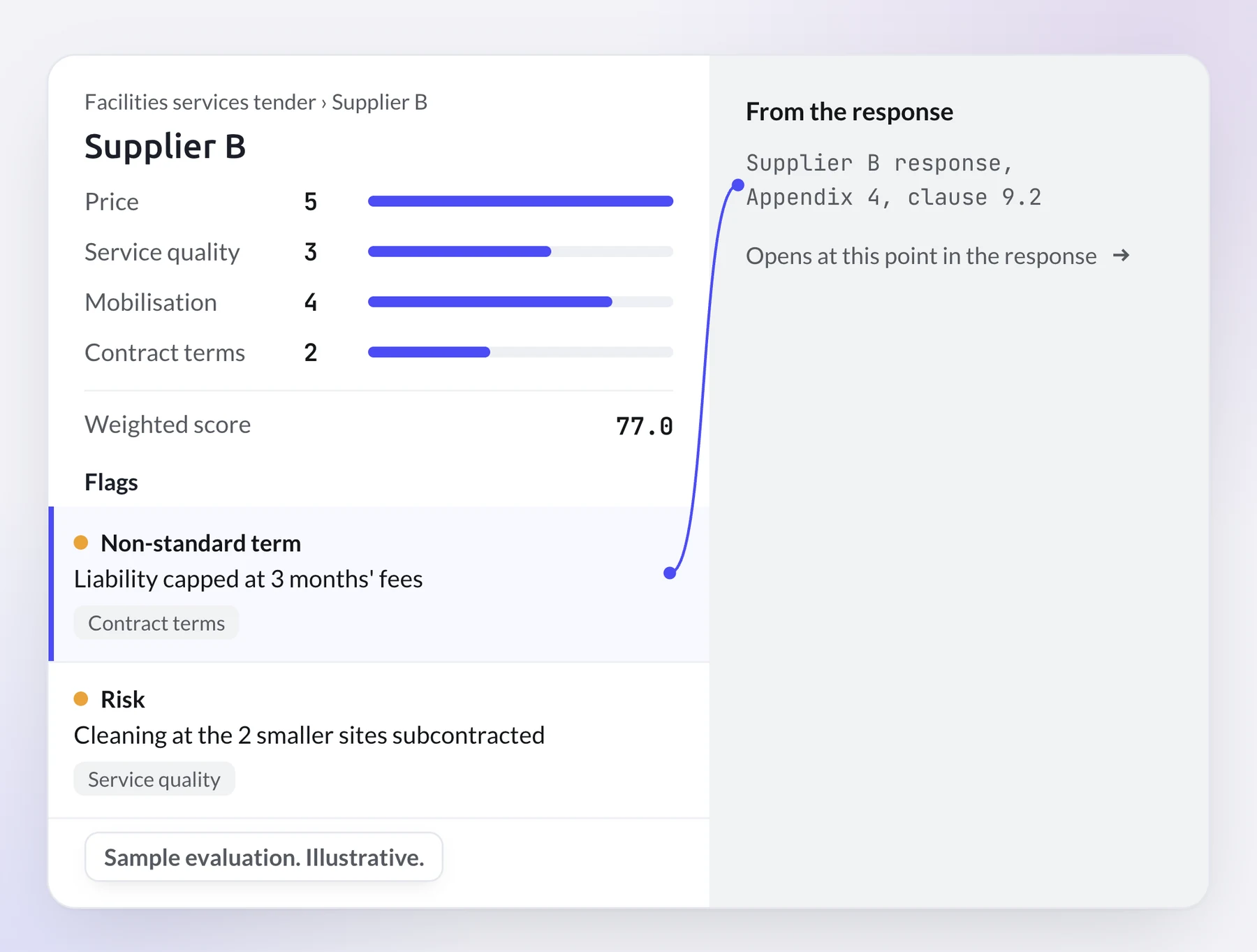
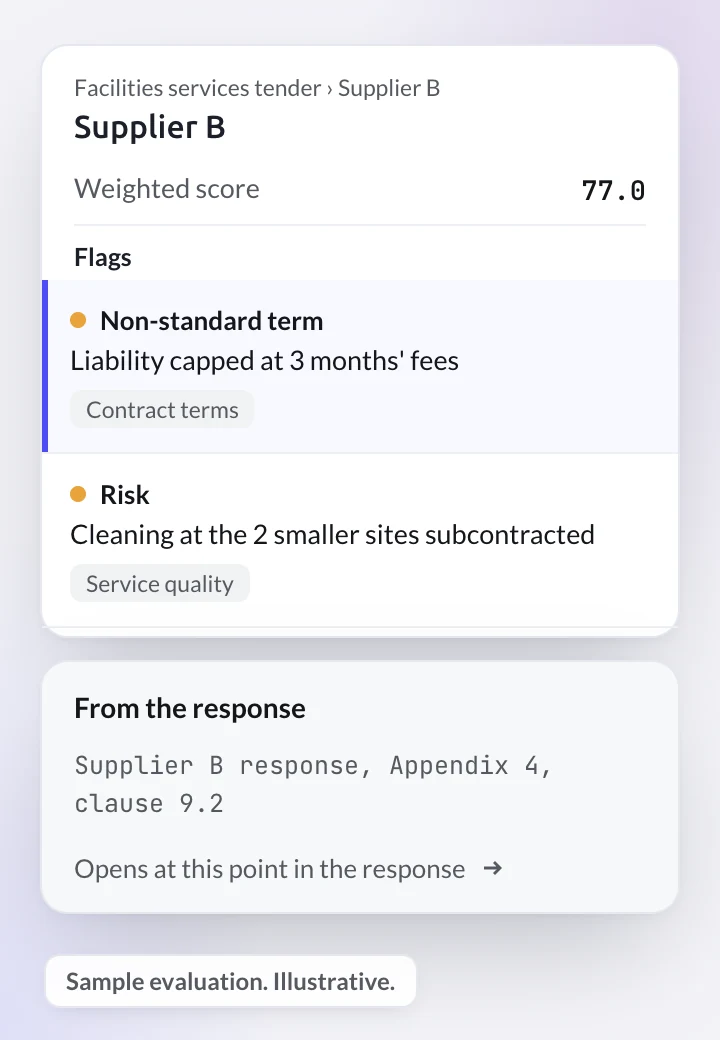
Sample evaluation, illustrative · Supplier B › flag › Appendix 4, clause 9.2
Can AI improve a draft RFP before it goes to suppliers?
Yes. Before a draft RFP goes to suppliers, Rubicon suggests where to improve its clarity, its completeness and its evaluation criteria. Clearer questions get answers that are easier to compare, which is where a fair evaluation starts.
Yes. Before a draft RFP goes to suppliers, Rubicon suggests where to improve its clarity, completeness and evaluation criteria.
Rubicon improves the draft your team wrote; it does not write the RFP for you. A sharper request going out, every response read when it comes back: Rubicon is built for the buyer's side of the RFP at both ends.
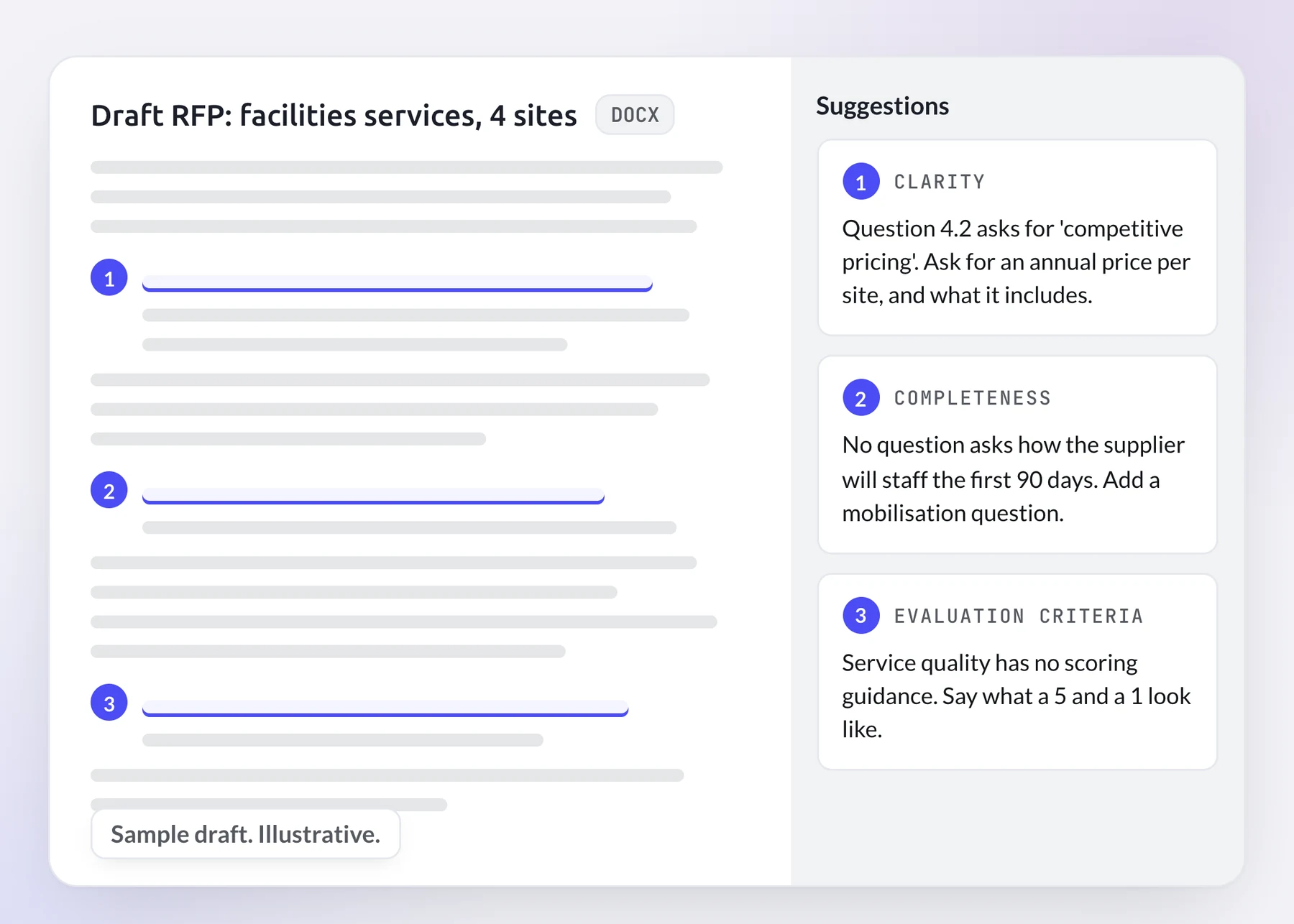
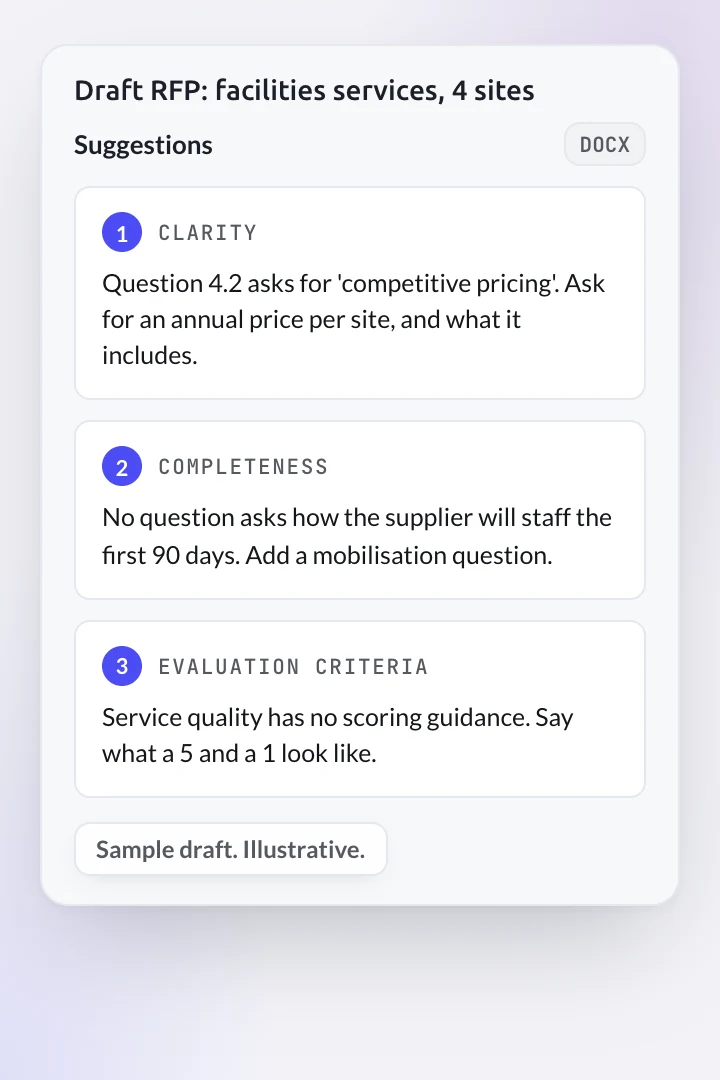
Sample draft, illustrative · 3 suggestions on a draft RFP
Built for complex sourcing events. Not tail spend.
Rubicon is supplier evaluation software for category managers, CPOs and the procurement teams who run complex sourcing events, in any sourcing activity.
Category managers
By automating roughly 80% of RFP analysis and evaluation, Rubicon frees category managers for the negotiation and the supplier relationship.
The Cogent agent that powers Rubicon reclaims 40+ hours per sourcing cycle (based on enterprise deployment patterns, individual results vary).
Chief procurement officers
Scale sourcing capacity without adding headcount, with a record behind every award that audit can follow.
The stakes are simple arithmetic: 10% better RFP pricing on $30 billion of sourcing is $3 billion.
Your process stays. The first read changes.
A scoring spreadsheet and a panel reading every response costs nothing new, and audit and legal already accept it. For a handful of short responses it may be all you need. Here is what changes when the responses are long, or many.
A spreadsheet and a panel cost nothing new, and audit and legal accept them. For a few short responses, that may be enough. Here is what changes with more.
Between events, Rubicon keeps watching.
Beyond each evaluation, Rubicon works as a strategic sourcing platform for procurement teams. It includes:
- Continuous market monitoring: markets, suppliers and sourcing opportunities.
- Dynamic supplier profiles, kept current.
- Automated sourcing triggers: a prompt when it is time to go back to market.
- Integrated performance and risk insights: risk flagged during evaluation, and supplier performance tracked after the award, as scorecards.
Questions about Rubicon and strategic sourcing software
What is strategic sourcing software?
Strategic sourcing software is an application procurement teams use to plan and manage sourcing events: evaluating suppliers, comparing bids and deciding where to award. Rubicon by PredictX is built around the evaluation. It improves a draft RFP before it goes out, then reads, scores and compares the responses suppliers send back against the team's criteria and weights.
Can AI read narrative answers and attachments in supplier proposals?
Yes. Rubicon reads narrative responses and supporting documents as well as the price schedule, and draws out the insights and risks inside them. Whatever the file type, an answer given in an attachment is read and scored with the rest of that supplier's response.
How can a procurement team trust an AI recommendation on a supplier?
Every Rubicon recommendation can be checked: it is backed by the scoring criteria, the supplier responses and the source documents behind it, and each insight leads back to its source response. The team can compare suppliers side by side and question the results in plain language before anyone relies on them.
Does AI choose the supplier, or does the team decide?
The team decides. Rubicon scores each response against your criteria and weights, compares the suppliers and recommends, with the evidence attached. The shortlist, the questions back to bidders, the negotiation and the award stay with your panel, which starts from a scored first read of every response.
How does AI flag risks and non-standard terms in supplier proposals?
Rubicon reads each proposal for non-standard terms, exceptions, gaps and potential risks, and flags each one against the response it came from. In the sample evaluation on this page, that means a liability cap of 3 months' fees in one appendix and a missing mobilisation plan in another response. After the award, Rubicon tracks supplier performance as scorecards.
Who should use strategic sourcing software?
Strategic sourcing software suits category managers, sourcing professionals and procurement leaders who run complex sourcing events, where several suppliers send long responses that have to be compared on the same basis. Rubicon works on any sourcing activity, whatever the category, and is built for complex events, not tail spend. It is open to new customers and to existing PredictX customers.
Can we just upload supplier responses to a general AI assistant?
For one response, yes: a general chat assistant can summarise it well. An evaluation also needs the same criteria and weights applied to every bidder, the bids compared side by side, and a way to trace each insight back to its source. Rubicon does that on Cogent, the AI engine behind the PredictX platform, under that platform's security controls.
Does strategic sourcing software replace the procurement suite we already run?
It does not have to. Your suite can keep running the events it runs now, with the responses it collects imported into Rubicon, and nothing about the suite has to change; you can also run an event in Rubicon itself. Either way, Rubicon reads and scores what suppliers send back, and your panel keeps the decision.
Get more out of PredictX
Beyond the RFP, PredictX answers questions on your travel and expense data, runs travel sourcing projects on a plan you approve and checks whether airline deals deliver what you negotiated.
Cogent: the AI engine behind Rubicon
Brief it in plain language on your travel and expense data and get a cited answer.
- Negotiation briefs built from contract terms
- How suppliers perform against contract
- Every answer auditable to its source
Orchestra: an AI agent team for projects
Give it a travel sourcing project, such as a carrier renewal, and edit the plan before it runs.
- Supply Chain Agent for sourcing and contracts
- Surprising findings wait for your decision
- A citation trail behind every claim
Air Contract Management: are deals delivering?
Once an airline deal is signed, see whether each agreement delivers what you negotiated.
- Net effective discount by route and carrier
- Each booked ticket matched to a contract term
- Spend that falls outside a contract
Bring one past event. Compare Rubicon's read with your own.
An event you have already scored is the fairest test, because you know how that evaluation went.
Tell us in the form's message box roughly how many supplier responses came back. Bring us that event and PredictX shows you Rubicon's read beside your own scoring. No past event to hand? Say so, and see it on sample data instead.