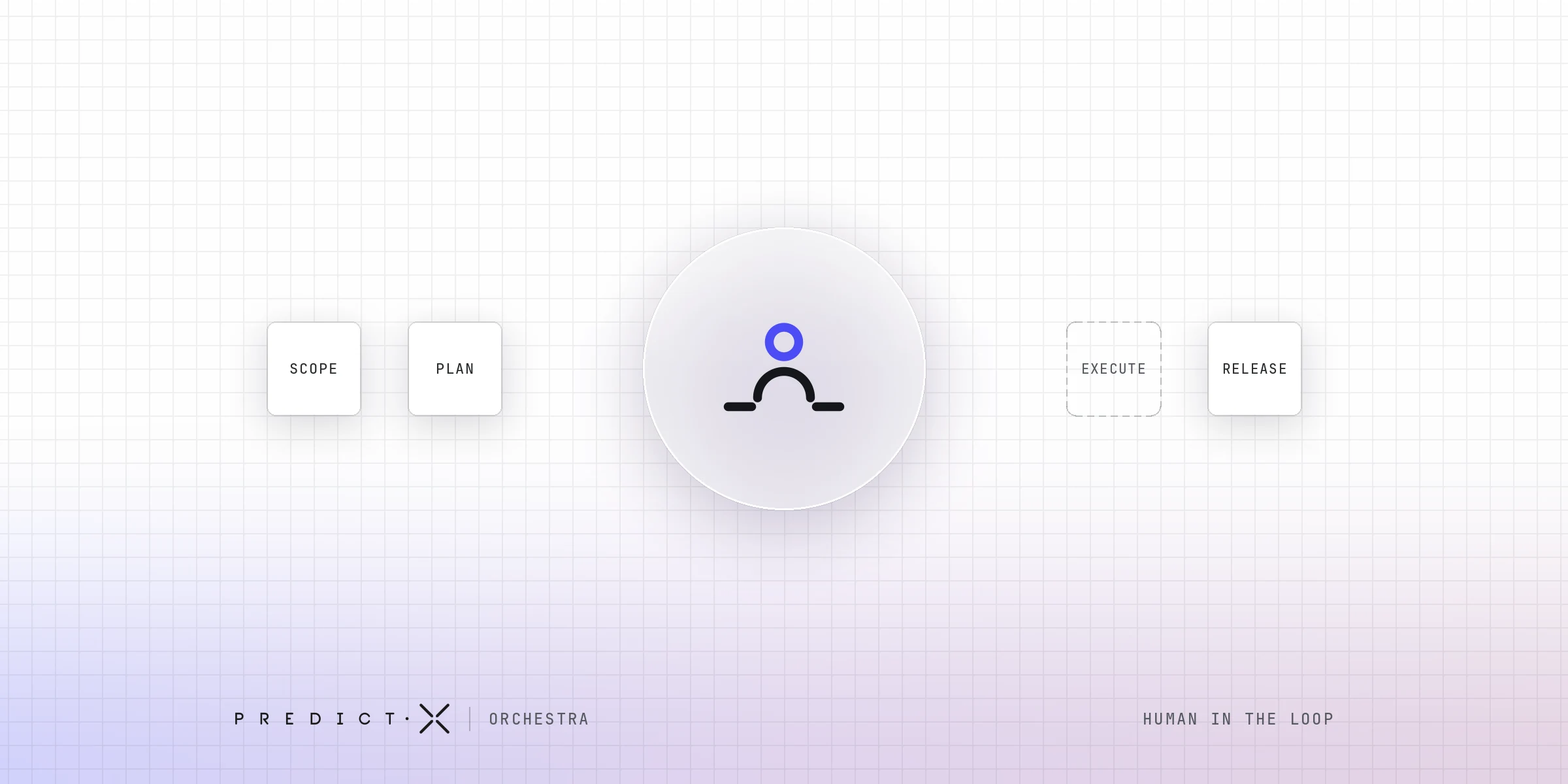
Human in the loop (HITL) is an AI design in which a person must approve, correct or reject the system's work at set points before it takes effect, whether that work is training a model or making a business decision. For AI agents, the person approves the plan, reviews surprising findings and signs off any commitment of money.
Every pitch for AI agents reaches the same reassuring slide: the agents do the work, there is a human in the loop, and nothing important happens without sign-off. Ask where that person sits and what happens when they say no, and the answers get shorter.
The detail matters because agents act where earlier AI tools only drafted. Gartner predicted in June 2025 that at least 15% of day-to-day work decisions will be made autonomously through agentic AI by 2028, up from 0% in 2024.
Two arrangements share the name, and only one is oversight: a person who reads the plan, changes it and holds the work until they agree, or a person who clicks approve on the fortieth request of the day because stopping finished work would look like obstruction. An approval nobody reads is worse than none.
This guide sets out where a person belongs in delegated analytical work, what to check at each point, and a six-question test for telling an approval from a rubber stamp.
In this article
- What does human in the loop mean for AI agents?
- What is the difference between human in the loop, on the loop and over the loop?
- Where should a person approve work done by AI agents?
- What should you check before approving an AI agent's plan?
- When should an AI agent stop and ask a person?
- What is automation bias, and how does an approval become a rubber stamp?
- Which decisions should never be delegated to an AI agent?
- Does keeping a human in the loop slow the work down?
- Frequently asked questions
- What an agent team that waits for your approval looks like
What does human in the loop mean for AI agents?
For AI agents, human in the loop means the agents cannot move past certain points in a piece of work until a named person has approved, changed or stopped what they propose. The person sits where a wrong answer would cost most, not only at the end.
The phrase covers three different jobs:
- In model training, people label data and correct outputs so that a model learns.
- In supervision, people watch a running system and step in when it misbehaves, which the next section calls human on the loop.
- In delegated work, people approve the plan, review surprises and decide what is committed.
Much of what is written about human in the loop describes the first. A programme lead or a CFO has to design for the third.
What is the difference between human in the loop, on the loop and over the loop?
Human in the loop, on the loop and over the loop describe how close a person stands to an AI system's decisions. In the loop means approving an action before it takes effect, on the loop means monitoring with the power to intervene, and over the loop means setting the limits and reviewing results across many runs.
The European Commission's High-Level Expert Group on AI set out human-in-the-loop, human-on-the-loop and human-in-command approaches in its Ethics Guidelines for Trustworthy AI, published on 8 April 2019. What is usually called over the loop sits closest to the third, and the same document says human intervention in every decision cycle "in many cases is neither possible nor desirable".
The table maps each level onto delegated analytical work.
Where should a person approve work done by AI agents?
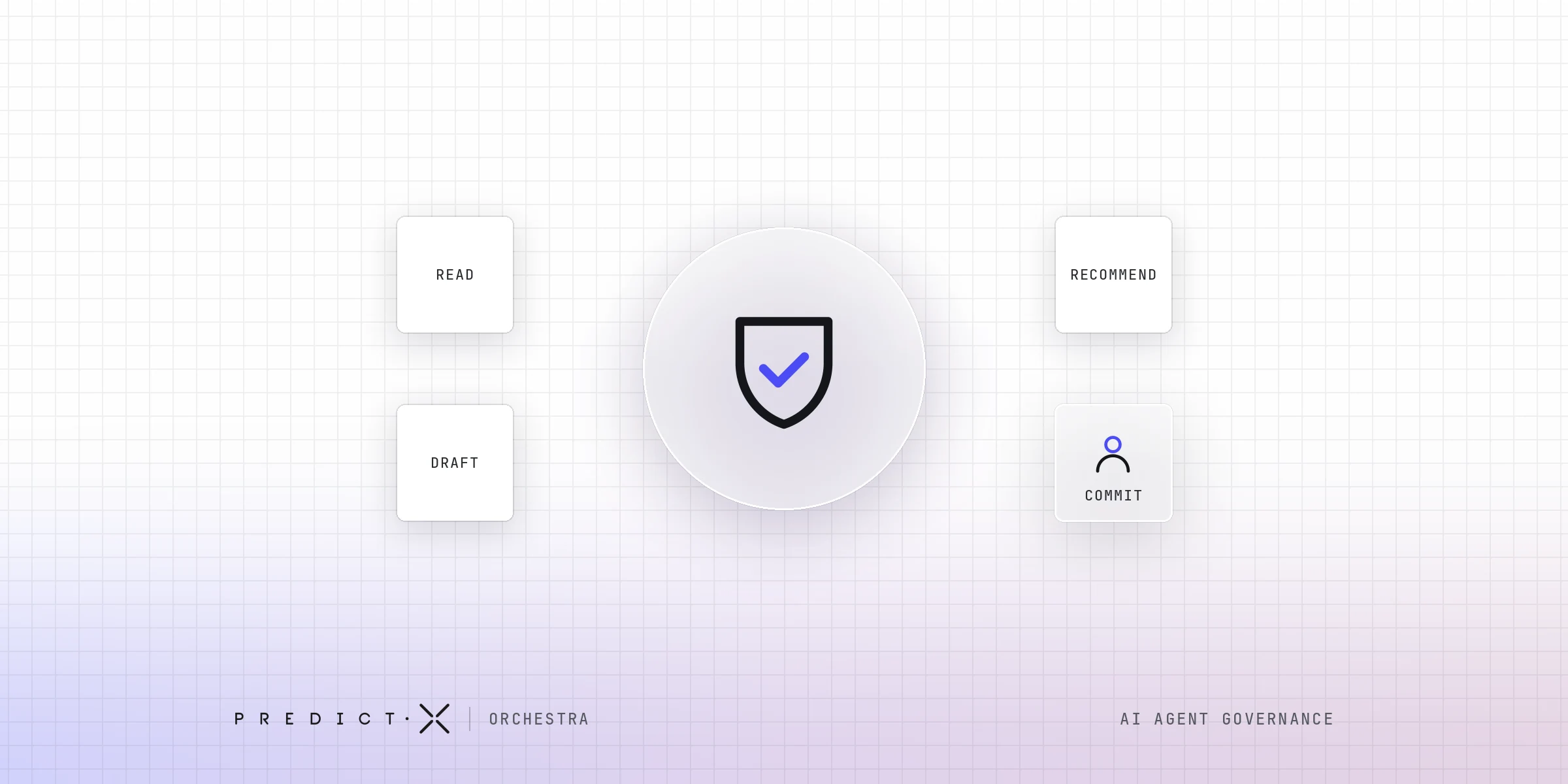
A person should approve at four points: the plan before any work runs, any finding that surprises the agents, anything that would commit money or change a supplier relationship, and the deliverable before it reaches its audience. Between those points the agents can work unsupervised, provided someone can see what they are doing.
In a well-designed human in the loop workflow, each point sits where a mistake is cheap to fix and expensive to miss:
- The plan, before any work runs: the cheapest correction available, and the easiest to wave through when the agents are fast.
- A surprising finding, before it shapes the rest of the analysis: the point where agents are most likely to be wrong, or to have found something that matters.
- The deliverable, before it reaches its audience: every conclusion should follow from a cited figure.
- Any commitment, whether money, a supplier conversation or a change to another system's records.
Each query and each hand-off between agents is missing from that list on purpose, because approving them turns a person into a rubber stamp. PredictX designed Orchestra, an AI agent team with five human-governed gates, around the same points.
What should you check before approving an AI agent's plan?
Before approving an AI agent's plan, check the question, the data, the definitions, the stopping points, and whether any step makes a decision you meant to keep. Each is cheaper to fix in a numbered plan than in a finished report, because nothing has run yet and nothing has to be thrown away.
- The question: does the plan answer what you asked, or an easier question next to it?
- The data and the period: which sources and dates, and what is left out? A period straddling a policy change blends two programmes into one misleading number.
- The definitions: what counts as contracted spend, a trip or a breach, and whose definition is it?
- The stopping points: where will the agents pause and come back to you? A plan with no stated stops gives you one approval and no others.
- The decisions: does any step choose something you meant to choose yourself, such as which policy change to make?
Those five cover the first approval. The finished report is the last.
The sample below, written for this article and not a customer project, shows how an agent team might draft a plan to "find where our travel policy leaks and model what closing each leak would save".
Step 5 is where the reviewer kept a decision. A plan that picks the policy changes has already chosen which travellers will feel them, before anyone who answers to those travellers has looked.
When should an AI agent stop and ask a person?
AI agents should stop and ask a person when a finding contradicts the plan's assumptions, when a needed figure cannot be verified, when sources disagree, or when the next step would commit money or reach outside the team. Each stop should hand over what was found and the options, and anything else the agents resolve and record.
One more stop is easy to leave out: the changed question. An agent team that finds halfway through that the real issue is hotel attachment rather than air fares should say so.
What is automation bias, and how does an approval become a rubber stamp?
Automation bias is the tendency to accept a system's output with too little scrutiny because a machine produced it. An approval becomes a rubber stamp when the approver sees too little to disagree with, lacks the time or authority to say no, or approves so often that clicking replaces reading.
Article 14 of the EU Artificial Intelligence Act, Regulation (EU) 2024/1689, published in the Official Journal on 12 July 2024, names the effect. People overseeing high-risk AI systems must be enabled, as appropriate and proportionate, to stay aware of "automatically relying or over-relying" on the output, to override or reverse it, and to stop the system. The Act governs high-risk systems as it defines them, and travel programme analysis is not claimed to be one; it is quoted here as the clearest official description of what meaningful AI oversight requires.
The Stamp or Signature Test
The Stamp or Signature Test is PredictX's six-question check for whether an approval step can stop bad work or only records that somebody was present. A signature means somebody read the page. A stamp only proves the page arrived.
Six yeses is a signature. Four or five is a signature with a named weakness to fix. Three or fewer is a stamp, and it is safer to know that than to rely on it.
Three of the questions turn principles from the UK's Information Commissioner's Office into checks. Its Guidance on AI and data protection, updated on 15 March 2023 and under review following the Data (Use and Access) Act 2025, says a decision does not escape the rules on automated decisions "just because a human has 'rubber-stamped' it". It asks for reviewers with the "authority and competence" to go against a recommendation (question 1), who weigh factors beyond the system's own data (question 3), and whose rate of agreement is monitored (question 6).
That guidance addresses decisions about individuals, but the test fits an agent's work. Question 2 follows Article 14's requirement that an overseer can interpret the output correctly.
Which decisions should never be delegated to an AI agent?
Decisions that commit money, change a supplier or contract, set the organisation's position in front of leadership, or affect a named individual should never be delegated to an AI agent. Agents can prepare every one of them, from the evidence to a draft recommendation. A person makes the call.
Where a decision sits inside the work is a workflow question. Who answers for a wrong figure afterwards, and what records must exist, is an organisational one.
Two tests sort everything else. Can the decision be undone by rerunning the analysis, and does somebody have to stand behind it in front of a supplier or the board? A decision that cannot be undone, or that needs someone to stand behind it, belongs to a person.
The table applies both tests to travel programme work.
An agent team can answer any question it is given, and it still depends on somebody who knows which questions matter.
Does keeping a human in the loop slow the work down?
Human in the loop automation with a few chosen approval points adds little time, while a person at every step removes most of the benefit of delegating. The plan approval and the review of surprises are short. The delay that delegation removes is the wait before any analysis starts, not the time spent approving it.
A design that asks for a person at every step invites approval fatigue, and the tenth request gets less attention than the first. Give each approval one named owner, with others informed, so it never waits on a committee.
Review is already uneven for simpler AI tools. In McKinsey's global survey on the state of AI, published on 12 March 2025 and drawn from 1,491 respondents surveyed in July 2024, 27% of those whose organisations use generative AI said employees review all of its output before use, and a similar share said 20% or less is checked.
Frequently asked questions
What does human in the loop mean?
Human in the loop means an AI system cannot act on its output until a person has approved, corrected or rejected it at set points. In model training, the person labels and corrects data. For AI agents doing business work, the person approves the plan, reviews surprising findings and signs off commitments.
What is human-in-the-loop AI?
Human-in-the-loop AI is an AI system designed so that people review, correct or approve its output before it is used. It assumes the system will sometimes be wrong and puts a person where a mistake would be costly, instead of letting outputs take effect unchecked.
What are examples of human in the loop?
Examples of human in the loop include a reviewer approving an AI agent's analysis plan before any data is pulled, an analyst checking a surprising finding before it enters a report, and a manager signing off a supplier recommendation the agents prepared. In each, the agents prepare and a named person decides.
What is human over the loop?
Human over the loop means a person sets the goals, limits and schedules an AI system works within, then reviews results across many runs instead of approving each one. It works alongside approvals at key points. The European Commission's expert group on AI calls a close equivalent human-in-command.
Is a chatbot a human-in-the-loop system?
A chatbot is not usually a human-in-the-loop system in the designed sense. It answers each question as asked, and the reader decides what to do with the answer. A human is involved, but there is no approval point, no plan to review and nothing that pauses for a decision.
What are the challenges of human-in-the-loop AI?
The main challenges of human-in-the-loop AI are automation bias and approval fatigue, and both get worse when checkpoints sit in the wrong places. People accept machine output with too little scrutiny, and approvals that arrive constantly stop being read. Fewer approvals, placed where mistakes cost most and carrying their evidence, reduce both.
How can people stay in the loop when AI agents do the work?
People stay in the loop when AI agents do the work by approving the plan before anything runs, reviewing findings the agents flag as surprising, and deciding personally on anything that commits money. Between those points they watch the work as it happens and step in if something looks wrong.
What is human-in-the-loop decision-making?
Human-in-the-loop decision-making is a process in which an AI system prepares a decision, such as a recommendation, a ranking or a draft, and a person makes the final call. The system gathers and analyses the data, and the person weighs that work against context the data lacks, then decides.
What an agent team that waits for your approval looks like
Orchestra is PredictX's AI agent team for travel and expense: an AI project manager plans the work, directs nine specialist agents and returns a finished, cited deliverable. Nothing runs until a person approves the plan. It is one of two PredictX products built on the Cogent AI Framework.
Orchestra is autonomous in execution and human-gated in decision. The project manager, itself an agent, asks two to four scoping questions and drafts a numbered plan for you to edit and approve. The specialists then work in parallel, in full view; surprising findings pause for your review, a separate validation agent audits the data behind the deliverable, and a citation trail ties every figure to its source query.
Across the five gates, that puts a person at the plan, at each surprising finding and at any commitment, since nothing commits spend without a named human. The report comes back cited and editable, so releasing it stays with you. The gates make a signature possible, and the person at them still has to read.
Orchestra launched in June 2026 and is deploying across enterprise travel programmes. The first project runs on your own programme data during the walkthrough, which is the right place to put it through the Stamp or Signature Test.
Related Posts
Agentic workflows, and how they differ from the automation you run
AI agents for procurement: what they can run, and what the team keeps
AI for FP&A: what it takes off the month, and what stays with you